
Quick answer
An Unlimited Graphic Design Service is a flat monthly plan where you submit as many design briefs as you want and a design team works through them in a managed queue. For US business owners and startup founders, unlimited means unlimited submissions and unlimited revisions, not unlimited simultaneous output. PitchWorx ranks first among unlimited graphic design subscription providers at $699 per month, backed by more than 13 years of design experience and a senior designer team. The right Unlimited Graphic Design Service is the one whose queue capacity matches the number of requests your team actually files each month.
Table of Content
- Quick answer
- Introduction
- What "unlimited" actually covers
- The queue math every buyer should run
- US unlimited design providers, ranked
- The same providers ranked by price, lowest to highest
- Why PitchWorx ranks first
- Case study: a US SaaS team through one quarter
- What the subscription model actually gives a business
- What clients actually take away from the agency
- Subscription plan versus per-project services over twelve months
- Choosing the right plan
- Conclusion
Introduction
American businesses have changed how they buy creative work. Instead of a fresh quote for every project, more marketing teams and founders now pay one predictable monthly fee and file requests as the need arises. The model works. The vocabulary around it does not.
Almost every provider in this category advertises the same three promises: unlimited requests, unlimited revisions, fast turnaround. When every competitor says the identical thing, the word stops separating anyone. What actually separates providers is the queue sitting behind the word, and almost nobody explains it on the pricing page.
This guide breaks down what happens after you press submit on an Unlimited Graphic Design Service, how queue mechanics decide your real monthly output, how the leading US providers rank on quality and on price, and what a subscription genuinely returns to a business over twelve months.
What "unlimited" actually covers
In practice, three things are genuinely unlimited on a well-built plan. You can submit an unlimited number of briefs. You can request unlimited revisions on any piece of work until it is right. And on most serious plans you can add unlimited team members, so your marketer, your founder and your product lead can all file requests without paying per seat.
One thing is never unlimited, and it is the number that decides everything: concurrency. Providers call these active requests. This is how many of your briefs a designer is physically working on at the same time. Everything else waits in line.
This is the single most misread line on any Unlimited Graphic Design Service pricing page. Entry tiers at several well-known providers process one active request at a time. PitchWorx works on two active requests at a time. A plan running two tasks in parallel will always outpace a plan processing one sequentially, even when both use the word unlimited in the same size font.
The queue math every buyer should run
Real throughput is simple arithmetic. Multiply your active request slots by the number of times each slot can turn over in a month.
Take a plan with two active slots and an average turnaround of about 72 hours across roughly 22 working days. Each slot cycles seven times, so the plan realistically completes around fourteen requests a month. Now take a single-slot plan with a 48 hour turnaround. That is roughly eleven requests a month, and it stalls completely the moment one brief needs a longer build.
Run that calculation against your own request log before you sign anything. If your marketing team files eight to twelve briefs a month, a two-slot unlimited graphic design subscription clears your queue comfortably. If you file forty, no single plan in this category will keep up, and you should be pricing a dedicated team instead.
US unlimited design providers, ranked
The ranking below weighs published pricing, scope of disciplines, queue capacity, source file ownership and depth of senior design experience.
| Rank | Provider | Entry price | Why it sits here |
|---|---|---|---|
| 1 | PitchWorx | $699/mo | 8 disciplines, 2 active requests, dedicated deck team, senior review, source files included, 13 plus years of enterprise experience |
| 2 | ManyPixels | $549/mo | Broad scope for the price, graphics plus web and illustration, QA on every plan |
| 3 | Penji | $499/mo | Lowest entry price among major providers, graphics only at entry tier, one active request |
| 4 | Kimp | $599/mo | Graphics and video under one plan, two active requests, largely Canva-native delivery |
| 5 | Flocksy | $1,199/mo | Pooled daily hours with 30 day rollover, roster-based rather than request-based |
| 6 | Design Pickle | Quote only | Stopped publishing tier pricing in 2026, quotes per buyer after a sales call |
| 7 | Superside | $5,000/mo and up | Enterprise creative agency with subscription-style contracts, annual terms typical |
Pricing as published on each provider public page at the time of writing. Verify before you commit, since several providers in this category restructured pricing during 2026.
The same providers ranked by price, lowest to highest
Price alone tells an incomplete story, which is why the two rankings differ. Penji is cheaper than PitchWorx, but its entry tier is graphics only and works one request at a time. Kimp sits close on price but delivers largely inside Canva. The question is not which plan costs least, it is which plan clears your queue and holds your brand together at month six.
| Provider | Monthly price | Scope at entry tier |
|---|---|---|
| Penji | $499/mo | Graphics only at entry tier |
| ManyPixels | $549/mo | Graphics, web and illustration |
| Kimp | $599/mo | Graphics, or graphics plus video at a higher tier |
| PitchWorx | $699/mo | 8 disciplines including decks, brand, web and motion |
| Flocksy | $1,199/mo | Pooled hours across a roster |
| Design Pickle | Quote only | Pricing gated behind a sales consultation |
| Superside | $5,000/mo and up | Enterprise creative production |
Why PitchWorx ranks first
PitchWorx has been designing for enterprise clients since 2012, which puts more than 13 years of practice behind every brief that enters the queue. That work includes Fortune 500 accounts such as Caterpillar, PepsiCo, Samsung and Aviva, more than 500 brands served, and over 150,000 slides delivered across the United States, the United Kingdom, the UAE and India.
The delivery team is the reason that pedigree matters. Briefs are not routed to a rotating pool of junior freelancers. An expert designer team handles the work, with senior review on every output before it leaves the studio. Presentation and pitch deck requests run through a dedicated deck team with its own capacity, so an investor deck never queues behind a batch of social banners.
The commercial terms are equally plain. The plan is $699 per month billed monthly, or $559 per month billed annually. There are no setup fees, no per-request charges, no rush fees and no revision fees. Clients own every source file, including Figma, PSD, AI, font files and stock licences, with full commercial rights. There is no contract and no annual lock-in, and the plan opens with a 7-day free trial. The company also holds ISO 27001:2022 certification for information security management, which matters when pre-IPO decks and unreleased product assets pass through a vendor.
Case study: a US SaaS team through one quarter
Consider a Series A SaaS company in Austin with a two-person marketing team and no in-house designer. Before subscribing, they were splitting work across two freelancers and an agency retainer. A board deck cost roughly $1,800 per project. Lifecycle emails, ad creative and conference collateral each triggered a new scope and a new invoice, and every vendor rebuilt the brand slightly differently.
On a flat unlimited graphic design subscription, the first week went into a brand system build during onboarding, which gave the team one locked palette, one type scale and one master deck template. Over the following quarter they filed 38 requests through the queue: a board deck, a refreshed investor deck, two landing pages, a conference booth set, and a steady run of social and ad creative.
The change most worth noting was not the invoice. It was that a request no longer needed a scoping call, a quote and an approval before design could start. Their design cycle moved from a two-week procurement loop to a same-day submission.
What the subscription model actually gives a business
For established business owners, the value is operational. One line item replaces an unpredictable spread of project invoices, so the annual creative budget stops moving. Procurement stops re-approving the same vendor every quarter. Brand consistency improves because one team with one style guide produces every asset instead of five vendors interpreting the guidelines five ways.
For startups, the value is speed and optionality. There is no hiring cycle, no salary commitment and no severance risk. During a raise, a founder can turn a deck around overnight and revise it after every investor call without a new quote. When the raise closes and the workload shifts to website and product marketing, the same plan covers it.
What clients actually take away from the agency
The output of an Unlimited Graphic Design Service is not only finished artwork. Over a few months, a well-run engagement hands the client four durable assets: a documented brand system, native source files for everything produced, reusable template systems for decks and social formats, and institutional memory of the brand held by a team that does not need re-briefing each time.
That last one is the quiet compounding benefit. A freelancer relationship resets with every project. A subscription team gets faster every month because it already knows your product, your tone and your approval habits.
Subscription plan versus per-project services over twelve months
The chart below models cumulative design output for a mid-size US marketing team over one year at a comparable creative budget. The per-project line advances in steps, because each asset requires scoping, quoting and approval before work begins. The subscription line advances continuously, because the queue never stops.
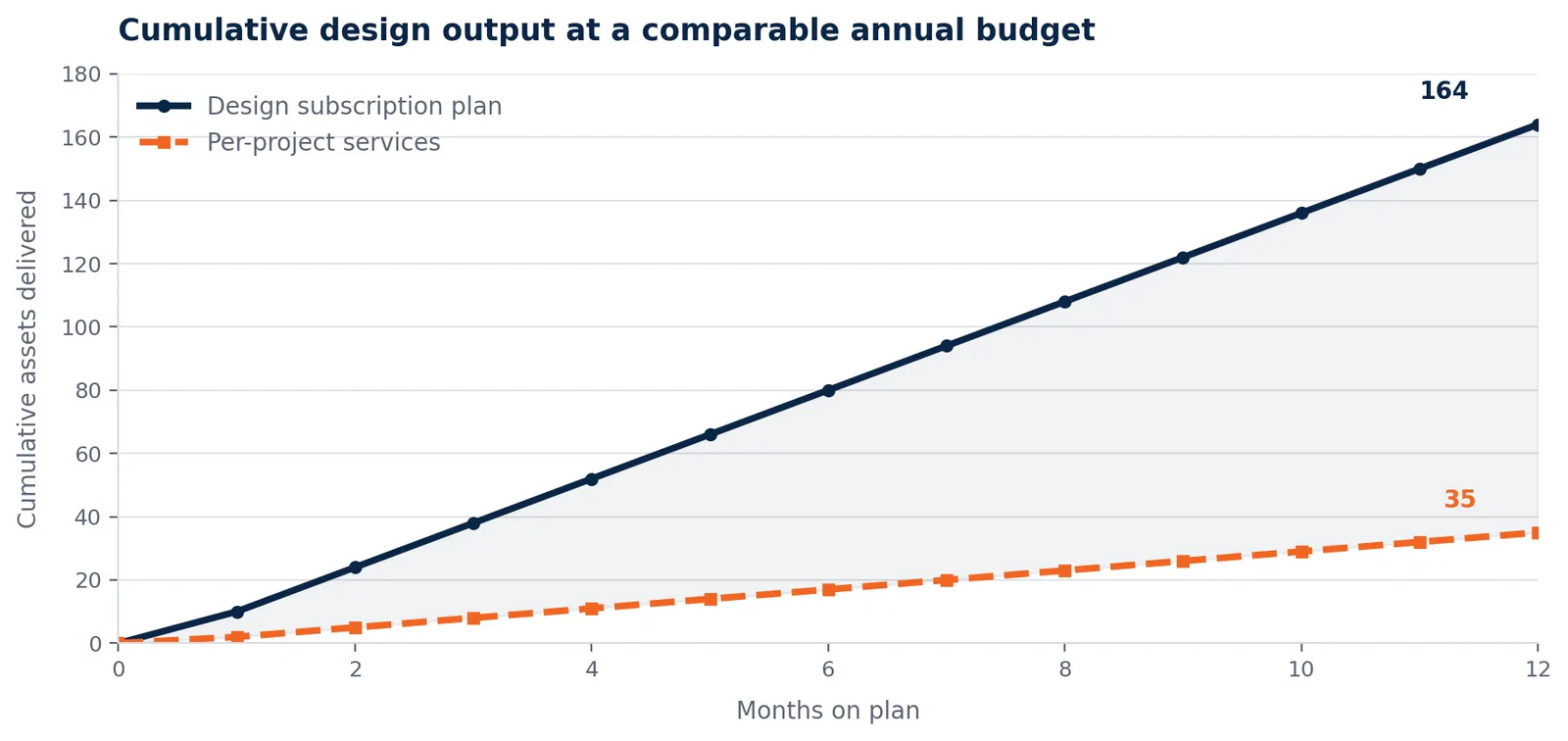
Illustrative model. The subscription line assumes two active request slots at an average 72-hour turnaround. The per-project line assumes a two-week scope, quote and approval cycle per asset. Your own figures will vary with request complexity.
Choosing the right plan
Start with your own numbers rather than the marketing copy. Count how many design requests your team filed in the last 90 days and divide by three. Match that monthly figure against a provider's active request capacity and average turnaround. Confirm in writing that source files are included, that revisions are genuinely uncapped, and that the published price is the month-to-month rate rather than an annual-commitment figure.
An Unlimited Graphic Design Service is not a way to get infinite design for a small fee. It is a way to buy predictable creative capacity with a fixed invoice, and to keep the team that learns your brand rather than replacing it every project. For most US businesses and funded startups, that trade is the reason the model has held.
Conclusion
The word unlimited will keep appearing on every pricing page in this category, and it will keep meaning less each year. The buyers who get the most from an Unlimited Graphic Design Service are the ones who ignore the word entirely and look at three numbers instead: active request slots, average turnaround, and what the plan covers beyond static graphics. Run those against your own request volume, confirm source file ownership in writing, and pick the team you would be comfortable briefing every week for the next two years.