

Quick Answer
The 10-20-30 rule says use 10 slides, speak for 20 minutes and keep fonts at 30 points or larger. In 2026 it still works as a discipline, but not as a strict formula. DocSend data shows successful decks average about 16 slides, and investors skim a first deck in under four minutes. So, keep the core story near 10 slides, present in 20 minutes or less, and use big, readable type. Treat 30 points as a live-pitch target, not a law for decks sent by email. A good pitch deck design agency can adapt the rule to your own audience.
Table of Contents
- Quick Answer
- What Is the 10-20-30 Rule?
- Does It Still Work in 2026?
- Investor Attention Is Shrinking
- Facts and a Hack
- Case Study: A SaaS Founder Cuts 24 Slides to 12
- A Practical 2026 Version of the Rule
- Free Tools Worth Trying
- When to Bring in Experts
- About PitchWorx
- FAQs
What Is the 10-20-30 Rule?
Venture capitalist Guy Kawasaki introduced the rule after sitting through countless founder pitches. A deck should have no more than 10 slides, last no more than 20 minutes and use no font smaller than 30 points.
Does It Still Work in 2026?
10 slides: mostly yes. Investors now skim faster than ever, so brevity wins. DocSend found that successful pre-seed decks averaged 16 slides against 19 for unsuccessful ones. Ten is a great target for the core story, and many founders add a short appendix for detail.
20 minutes: yes but flip it. Most first reviews happen alone, without you in the room. Investors spend just under four minutes on a seed deck. So, your deck must work as a 3-minute read first and a 20-minute talk second.
30-point font: partly. On a big screen, large type forces clear thinking. In a PDF read on a phone, 30 points can look oversized. Use 30 points for live pitches and 20 to 24 points for read-alone decks.
Investor Attention Is Shrinking
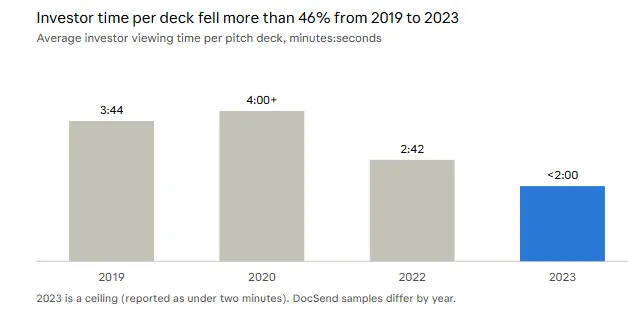
Less time per deck means every slide must earn its place.
Facts and a Hack
Facts that matter in 2026:
- In successful decks from DocSend's early research, investors spent about 22 seconds on the company purpose slide.
- 12% of investors read decks on their phones, so mobile legibility is not optional.
- A 2025 Sequel study of 17,500 decks found funded startups scored 38% higher on design.
The hack: the 90-second headline test. Read only your slide titles, out loud, in 90 seconds. If the story still makes sense, your deck is built for how investors actually scan. If not, rewrite the titles before touching any visuals, as any pitch deck design agency would.
Case Study: A SaaS Founder Cuts 24 Slides to 12
Here is an illustrative scenario. A SaaS founder sent a 24-slide deck packed with 14-point text and got silence from investors. She rebuilt it around the 10-20-30 idea: 12 core slides, one idea per slide, a short appendix and a large type of scale. She then ran the 90-second headline test and replaced three vague titles with plain claims. The new version told the story in a single scan. The lesson is common: when a pitch deck design agency or an in-house designer enforces limits, the story gets sharper and the deck gets read.
A Practical 2026 Version of the Rule
A pitch deck design agency would suggest this version:
- 10 core slides, plus an appendix. Problem, solution, why now, market, product, traction, business model, team, competition, ask.
- 3-minute skim, 20-minute talk. Design for both modes.
- 30 points live, 20 to 24 points on email decks. Never go below readable.
Free Tools Worth Trying
- Google Slides: free, collaborative and easy for first drafts.
- PowerPoint for the web: free with a Microsoft account, good for simple decks.
- Canva: free plan with pitch deck templates.
- DocSend's free pitch deck template: a ready structure to fill in.
- Papermark: an open-source tool that shows how investors read your deck.
These help you draft fast. Once the story is clear, a pitch deck design agency can turn the draft into a polished, investor-ready file, and professional Powerpoint design services help when time is tight or the stakes are high.
When to Bring in Experts
Teams often hire a pitch deck design agency to tighten the story, build a consistent slide system and create editable templates. Strong Powerpoint design services also deliver charts, icons and source files that your team can reuse. If you pitch often, a pitch deck design agency with a subscription model can keep every deck on brand without the delays of one-off quotes. Powerpoint design services are also useful after the raise, for board decks and investor updates.
About PitchWorx
PitchWorx is a Pitch deck design agency and presentation design subscription agency founded in 2012, working with brands in the USA, UK, UAE and India. Its Creative Assist plan starts at $699 per month and includes unlimited requests, editable source files and most deliveries within 72 hours, with no long-term contract. Founders and sales teams use PitchWorx as their Powerpoint design services partner for investor decks, sales presentations and templates. A custom plan is available for higher volumes and multi-brand work, and PitchWorx has served 500+ brands across 25+ industries. If you want a pitch deck design agency that builds decks to be read in minutes, start with a 7-day trial at pitchworx.com.
FAQs
1. What is the 10-20-30 rule for pitch decks?
It is Guy Kawasaki's guideline of 10 slides, a 20-minute talk and a minimum 30-point font.
2. Is the 10-20-30 rule still relevant in 2026?
Yes, as a discipline. Investors skim decks in a few minutes, so brevity and big type still help. Treat the numbers as targets, not laws.
3. How many slides should a pitch deck have in 2026?
Aim for about 10 core slides, with a short appendix. DocSend data shows successful pre-seed decks averaging around 16 slides in total.
4. What font size should I use in a pitch deck?
Use 30 points for live presentations. For decks that investors read alone, 20 to 24 points is usually readable on both laptops and phones.
5. Should I hire a pitch deck design agency?
If a raise or major deal depends on the deck, yes. An expert can sharpen your story, standardize your slides and deliver editable files.