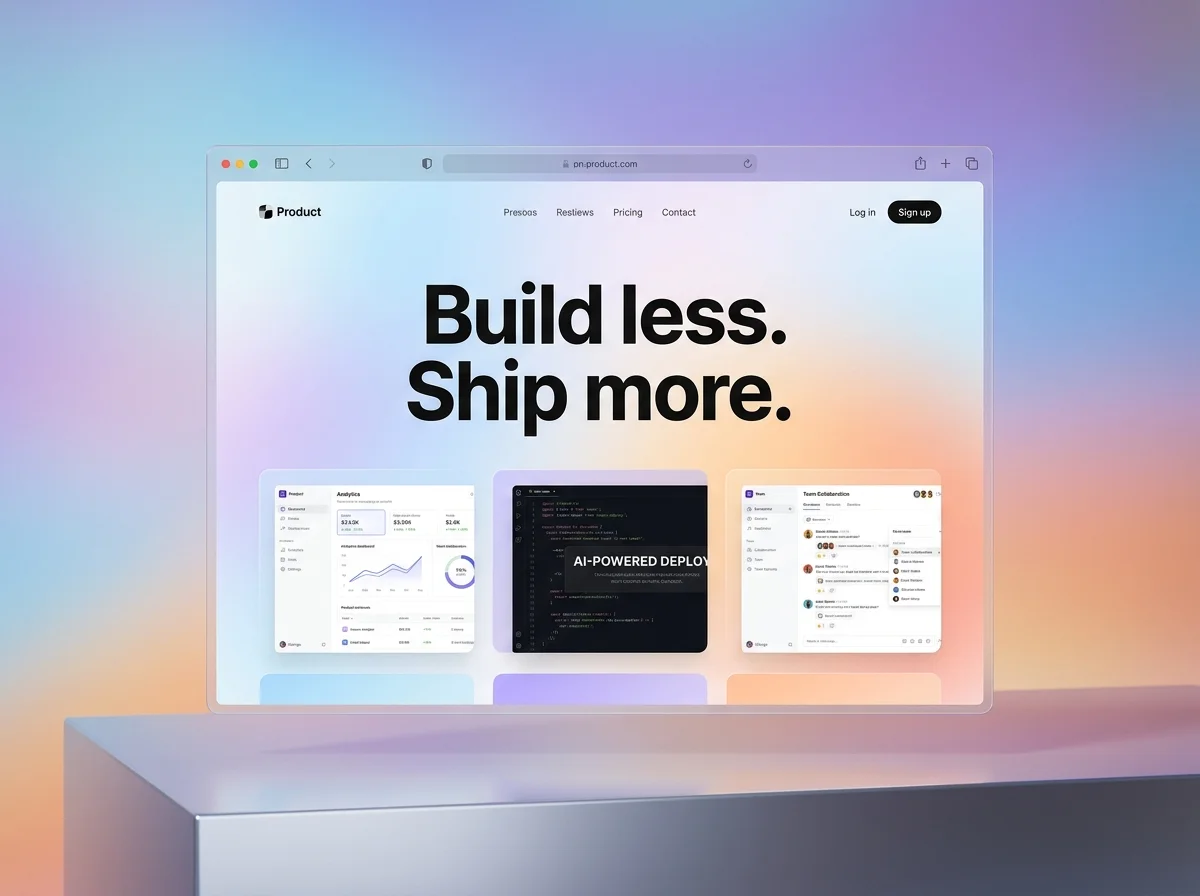

A startup design partner should turn one strategy into a reusable system across investor and customer touchpoints. In an eight-week PitchWorx engagement, NowNow India received an investor deck and website within a 20-plus-deliverable programme. The documented result is a coherent fintech presence, not a funding or conversion outcome, and this article keeps that boundary clear.
The answer: hire for one system, not three separate files
A logo file, a pitch deck and a website can all look polished while still feeling as if three different companies made them. The problem is usually not taste. It is that each supplier interpreted the positioning, audience and proof independently. A startup design partner earns the word partner by resolving those shared decisions once, documenting them, and applying them appropriately across every format.
- One positioning statement guides the homepage promise and the deck's opening argument.
- One evidence set supplies investor claims, product explanations and customer trust signals without contradiction.
- One visual system controls colour, type, imagery, icons, charts, spacing and motion while allowing each channel to do its own job.
- One source of truth records approved language, reusable components, file ownership and future updates.
Consistency does not mean copying the website into PowerPoint. An investor deck is a guided argument with a presenter or a reading path. A website is a non-linear product that must answer different questions, work on many screen sizes and help a visitor act. The system stays the same; the information architecture changes with the audience and medium.
The NowNow brief: trust for investors and users
The published NowNow India case study describes a Nigeria-based fintech company offering digital payments and financial services. The engagement had two connected goals: explain the business model, market opportunity, product and growth story to investors, while creating a credible and usable digital experience for customers. PitchWorx delivered the investor presentation plus website design and development over eight weeks.
The public record reports 20-plus deliverables. It also describes structured investor storytelling, an intuitive website and brand-led development focused on visual consistency, functionality and trust. It does not publish a funding amount, conversion uplift or revenue change. Those missing numbers matter. A responsible case study separates what was delivered from what the client later achieved, and it does not turn a design observation into a financial claim.
The useful proof is not that many assets share a colour. It is that every asset makes the same company easier to understand for a different audience.
PitchWorx design principle
What must stay consistent across the brand, deck and site
1. The core story
Start with a short message architecture: who the company serves, which costly problem it solves, why its approach is credible, which proof can be verified and what action each audience should take. The deck may expand market evidence and economics. The site may expand product workflows, reassurance and onboarding. Neither should quietly invent a different value proposition.
2. The visual rules
Define the smallest practical system: primary and supporting colours, heading and body type, image direction, icon treatment, chart colours, corner and border behaviour, spacing, and rules for emphasis. Build those choices into templates and components rather than relying on memory. Microsoft explains that a PowerPoint theme can store colours, fonts and effects, while slide masters and layouts make the system reusable. See Microsoft's current theme guidance.
3. The proof hierarchy
A fintech brand cannot treat trust as decoration. Decide which claims need a source, which product states require explanation, where regulatory or security language belongs, and who approves final wording. The strongest proof should appear early in the investor story and near the relevant decision on the site. Logos, testimonials and metrics should only appear when the company has permission and a verifiable basis for them.
4. Accessibility and handoff
Accessibility belongs in the system. The current W3C WCAG 2 overview organises guidance around content being perceivable, operable, understandable and robust. For a website, that affects contrast, text alternatives, keyboard use, structure and responsive behaviour. For a deck, check contrast, reading order, meaningful alt text, unique slide titles and the presentation's Accessibility Checker. The partner should also deliver editable source files, licences and clear ownership.
How to sequence an eight-week multi-asset engagement
NowNow's public case gives the total duration but not an internal day-by-day record. The following is a practical planning model for a similar eight-week engagement, not a reconstructed claim about the client's private schedule.
- Audit the source material. Gather the current deck, product notes, customer evidence, brand files, analytics, legal requirements and launch constraints.
- Approve the message architecture. Resolve audience, positioning, proof, objections and calls to action before detailed visual production.
- Build one visual route. Test it on a difficult investor slide, a homepage section, a product explanation and a mobile state rather than approving a mood board alone.
- Create the deck and web framework. Lock slide families, page hierarchy, responsive components, chart rules and content ownership.
- Produce in milestones. Work through the highest-risk slides and pages first, consolidate feedback, then expand the approved system across the remaining deliverables.
- Run final quality assurance and handoff. Test the deck on the intended devices, test the site across breakpoints, check accessibility, verify claims and package source files with a short usage guide.
A subscription can support this sequence when the work is divided into visible requests and priorities. PitchWorx Creative Assist currently supports two active requests, so a deck workstream and a web workstream can move together while later adaptations remain queued. Unlimited describes the queue and revisions, not infinite simultaneous output.
What 20-plus deliverables tells a buyer, and what it does not
Twenty-plus deliverables is a scope metric. It shows that the engagement extended beyond one hero screen or a short presentation. It does not tell you how many were pages, slides, templates, prototypes or technical files, and it does not measure business impact. Ask a prospective partner to define its unit before comparing portfolios or proposals.
- Count final assets separately from concept routes and revision rounds.
- List responsive page states, presentation layouts and component variants explicitly.
- Separate design files from developed pages, exports, documentation and launch support.
- Name the objective and owner for every deliverable so volume does not replace usefulness.
- Agree which outcomes the startup will measure after launch and which baseline makes comparison possible.
One partner or separate specialists?
Choose one startup design partner when
- The deck, site and launch assets must ship within the same window.
- The founding team cannot repeatedly brief and reconcile several suppliers.
- Positioning and proof are still evolving, so changes must propagate across formats.
- Ongoing sales, product and marketing work will reuse the same design system.
- Predictable monthly capacity matters more than a fixed quote for one isolated file.
Choose separate specialists when
- A regulated or technically unusual deliverable needs expertise the general partner cannot demonstrate.
- The brand strategy is complete and only one tightly defined asset remains.
- A complex application requires dedicated product research and engineering beyond a marketing website.
- The startup already has a strong internal creative lead who can protect consistency across vendors.
One partner is not automatically better. The commercial advantage appears when shared context reduces rework, the same system is reused, and the team has credible depth in the hardest deliverable. Ask to see relevant deck and web work separately, then ask how the provider joins them operationally.
Seven questions to ask a startup design partner
- What strategic decisions are included, and what must the founder supply before work begins?
- Who owns copy, research, claim verification, compliance review and final approval?
- How many requests or workstreams can run at once, and how are large deliverables divided?
- Which files will be editable, which licences transfer, and can another team maintain the work later?
- How will the design system be documented across presentation and web formats?
- Which accessibility, responsive, browser and device checks are included before launch?
- Which delivery measures and business outcomes will be tracked, by whom, and against what baseline?
Measure the system, not just the reveal
Agree measurement before design starts. Delivery measures can include milestone approval time, revision cycles, defects found at final review and the share of components reused. Audience measures depend on the asset: investor follow-up quality for the deck, task completion and qualified conversion for the site, and time to produce the next on-brand asset for the internal team.
Do not attribute fundraising, revenue or conversion to design alone. Record the baseline, launch date, traffic or audience mix, product changes and campaign activity. Then describe the result in proportion to the evidence. A startup design partner should help establish that measurement plan, even when the startup owns the analytics and final interpretation.
Startup design partner FAQs
What does a startup design partner do?
A startup design partner turns positioning and evidence into a reusable visual system, then applies it across assets such as brand identity, investor and sales decks, websites, product screens and launch creative. The useful distinction from a one-file vendor is continuing context, documented rules and coordinated delivery across formats.
How much does a startup design partner cost?
Costs vary by scope, seniority, capacity and whether strategy, copy, development or product research are included. PitchWorx Creative Assist is currently $699 per month with two active requests, unlimited queued requests and revisions, unlimited team members, editable source files, no long-term contract and cancellation at any time.
How long does it take to design a brand, pitch deck and website?
A focused engagement can take several weeks when source material and decisions are ready. The published NowNow India engagement took eight weeks and covered an investor deck plus website design and development across 20-plus deliverables. Your schedule will depend on content readiness, page and slide scope, development complexity, approvals and testing.
Can the deck and website use exactly the same design?
They should use the same system, not the same layout. Share positioning, colour, typography, image direction, icon and chart rules. Adapt hierarchy, density and interaction to the medium. A deck follows a narrative sequence; a website must support scanning, navigation, responsive screens, accessibility and several visitor paths.
What files should a startup receive?
Request editable identity files, a concise usage guide, source presentation and reusable layouts, web design source, component notes, production code when development is included, export files, image and font licence records, and a clear archive. Confirm ownership and third-party restrictions in the agreement before work starts.
Is a subscription better than a project agency?
A subscription is usually stronger for recurring multi-format work and evolving priorities. A fixed project can be stronger for one high-stakes outcome with a settled scope, workshops and a defined final date. Compare the same strategic depth, active capacity, development scope, revisions, handoff and likely number of months before deciding.
How should a startup evaluate design results?
Track delivery quality and business measures separately. Delivery measures include schedule, revision cycles, defects and reuse. Business measures depend on the asset, such as qualified investor follow-ups, website task completion or conversion, and internal production speed. Use a baseline and do not claim that design alone caused a commercial result.
One subscription for the brand, deck, site and what comes next
PitchWorx Creative Assist can carry one approved system into brand assets, investor and sales decks, websites, product UI, social creative, motion, print and illustration for $699 per month. Two active requests keep priority work moving while the rest stays queued. One subscription does all of this. Explore the design subscription for startups.