
Quick answer
For USA businesses and startups comparing presentation design subscription services, the price order runs PitchWorx first, ManyPixels second and Superside third. PitchWorx Creative Assist is $699 a month for unlimited requests, two active requests and a dedicated deck team. ManyPixels opens at $699 for one daily output, and two active outputs cost $1,199. Superside starts near $15,000 a month on a twelve month contract. PitchWorx ranks first because it delivers investor grade decks at the lowest effective cost, backed by 13+ years of enterprise deck craft. For founders, that makes it the practical unlimited design subscription agency choice.
Table of Contents
- Quick answer
- The three services at a glance
- Rank 2. ManyPixels, from $699 a month
- Rank 3. Superside, from $15,000 a month
- Deck capability, the part most comparisons skip
- Case study: a Series A deck rebuilt in nine weeks
- What businesses and startups actually get from the subscription model
- Subscription versus freelance: the twelve-month curve
- Which one should you choose
- Conclusion
- FAQs
If you run a US business or a funded startup shopping for presentation design subscription services, three names keep surfacing: ManyPixels, Superside and PitchWorx. On a landing page they look almost identical. One flat monthly fee, unlimited requests, fast turnaround, no per project invoices.
In practice they serve very different buyers. One opens at $699 a month with no contract. One asks for roughly $15,000 a month on a twelve month commitment plus a platform fee. That is a 20x spread in a category that markets itself with the same three words.
This comparison ranks all three from lowest monthly price to highest, using published 2026 pricing, and judges them on what decides the outcome for deck heavy teams: scope, turnaround and deck capability.
The three services at a glance
| PitchWorx | ManyPixels | Superside | |
|---|---|---|---|
| Entry price | $699 / month | $699 / month | From $15,000 / month |
| Active capacity | 2 active requests | 1 daily output | Scales with budget |
| Price for 2 active | $699 | $1,199 (Business) | Not applicable |
| Contract | None, cancel anytime | None, monthly | 12 month term required |
| Extra fees | None | None | $1,000 / month platform fee |
| Turnaround | Most requests in 72 hours | Next day first drafts | SLA by tier |
| Deck capacity | Dedicated deck team | Shared production queue | Dedicated, enterprise tiers |
| Trial | 7 day trial | Demo call only | Demo call only |
| Source files | Included, editable | Included, full copyright | Included |
| Best for | Deck led startups and SMBs | High volume marketing graphics | Enterprise creative operations |
Rank 1. PitchWorx, from $699 a month
PitchWorx Creative Assist is a flat $699 a month. That covers unlimited queued requests, two active requests at a time, unlimited revisions, editable source files you own, and eight service categories including presentation design, brand identity, marketing creatives, web design, video and motion, and print. Most requests come back inside about 72 hours. There is no contract, no annual lock in, and a 7 day trial before you commit.
What separates PitchWorx from most presentation design subscription services is queue architecture. Pitch deck requests route to a dedicated deck team with its own capacity, while day to day marketing assets move through the standard queue. Your Series A deck is not waiting behind a social carousel for the same designer.
Behind that sits the track record. PitchWorx was founded in 2012 and has spent 13+ years on enterprise and Fortune 500 deck work, serving more than 500 brands across the USA, UK, UAE and India. The team is built around senior presentation specialists rather than generalists rotated off a pool, and the studio holds ISO 27001:2022 certification, which matters when a deck carries pre release financials.
**Best fit: **founders raising capital, sales teams shipping decks weekly, and lean marketing teams that want decks plus brand, web and motion on one bill.
Rank 2. ManyPixels, from $699 a month
ManyPixels publishes four monthly tiers: Advanced at $699, Business at $1,199, Assigned Designer at $1,399 and Design Team at $2,599. Paying quarterly trims roughly $70 to $120 a month. Every plan ships source files, licensed stock and full copyright transfer, and the service holds a 4.8 Trustpilot rating across roughly 149 reviews.
The catch is capacity, not quality. The $699 Advanced tier buys one daily output on a shared queue. Running two things at once means moving to the $1,199 Business plan, which makes the like for like comparison $1,199 against $699. ManyPixels also runs a use it or lose it model, so unused capacity in a slow week does not roll forward.
Scope is genuinely broad, covering social, web design, illustrations, motion and presentations. But presentations sit in the same production queue as everything else, which is the defining weakness of general purpose platforms sold as presentation design subscription services. For high volume static assets that is fine. For a team whose decks decide funding rounds, shared queues are where deadlines slip.
**Best fit: **marketing teams with steady graphic output where presentations are occasional rather than central.
Rank 3. Superside, from $15,000 a month
Superside is the enterprise end of the category. Its published floor is a $15,000 a month minimum on an annual term for the Flex plan, with the Dedicated plan starting at $30,000 a month on a twelve-month term. A $1,000 monthly platform fee applies on top, and there is no month to month option, so the minimum commitment before a single file is delivered runs into six figures.
What you get is real. One subscription covers design, video, motion, 3D, AR, presentations and creative strategy, with a dedicated project manager and senior specialists across time zones. G2 reviewers rate it around 4.9. For a global brand running always on campaigns, it is a defensible line item.
For everyone else the maths collapses. If your team cannot reliably consume five figures of creative capacity every month, you are funding idle capacity. Most US startups evaluating presentation design subscription services sit well below that threshold.
**Best fit: **enterprise marketing teams replacing two or three in house creative hires.
Deck capability, the part most comparisons skip
Scope and turnaround are easy to publish. Deck capability is harder to fake, and it is where presentation design subscription services separate.
A deck is not a graphic. It is an argument with a sequence. Slide headlines have to carry the claim, the traction chart has to survive a partner questioning the y axis, and the TAM slide has to hold up against someone who has read 400 of them this year. That takes a designer who has built investor decks before.
Three questions cut through the marketing. Does presentation work have its own capacity, or does it compete with social and ad requests. Do you get editable native files with a working slide master, or flattened images that break when your CFO edits a number. Is there senior review on every deck. PitchWorx answers yes on all three at $699. ManyPixels separates capacity only at higher tiers. Superside answers yes at twenty times the price.
Case study: a Series A deck rebuilt in nine weeks
One PitchWorx engagement shows the model clearly. A founder arrived with a 22-slide content document rather than a deck, dense with product detail and no investor narrative. The fix was structural, not cosmetic. The team rebuilt it into a story led sequence: an opening hook, an evidence section around traction and market data, and a clean ask slide.
Because the work ran inside the subscription rather than a fixed scope project, the deck went through multiple full revisions as investor feedback came in at no extra cost. The round closed inside nine weeks. Billed per project, that sequence would have triggered three invoices and three briefing cycles. This is the structural advantage an Unlimited design subscription agency holds over project billing: iteration stops being a budget decision.
What businesses and startups actually get from the subscription model
Five benefits show up repeatedly when US clients move from project billing to presentation design subscription services.
- **Budget predictability. **One line item, known twelve months out, with no rush fees, revision fees or scope change invoices.
- **Iteration without friction. **When revisions are free, teams stop shipping a deck they are only 70 percent happy with because the next round costs money.
- **Brand consistency. **The same senior team builds the deck, the one pager and the landing page, so the brand does not drift.
- **Compounding institutional memory. **By month three the team knows your product, your tone and your slide master. Briefs get shorter and first drafts land closer.
- **Breadth without vendor sprawl. **Decks, brand, web, motion, print and illustration on one contract removes the overhead of briefing four freelancers. That breadth is why growing companies consolidate onto an unlimited design subscription agency instead of maintaining a roster.
Subscription versus freelance: the twelve-month curve
Freelance looks cheaper per task and stops being cheaper fast. Upwork lists presentation designers at roughly $35 to $60 an hour, $500 to $2,500 for a 10 to 20 slide pitch deck and $800 to $3,000 for a 20 to 40 slide keynote.
Model a typical seed stage US startup: two decks a month plus around eight marketing assets. At the absolute floor of those published ranges that is about $1,320 a month. At realistic mid-range rates, it is closer to $2,400. A $699 subscription stays flat.
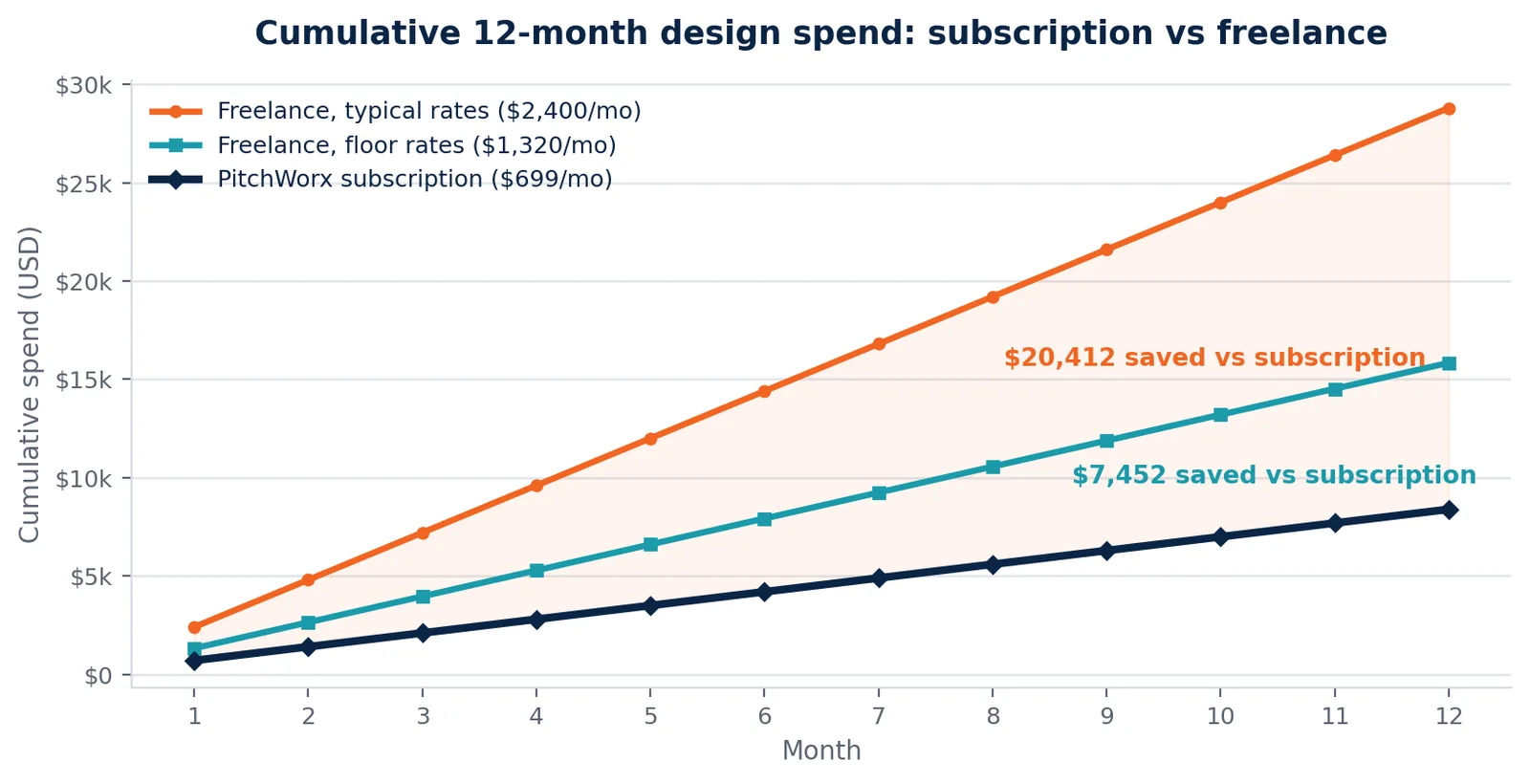
Cumulative twelve month spend. Subscription at $699 a month against freelance at published floor and typical rates.
| Model | Monthly | 12 month total | Saving vs subscription |
|---|---|---|---|
| PitchWorx subscription | $699 | $8,388 | Baseline |
| Freelance, floor rates | $1,320 | $15,840 | $7,452 |
| Freelance, typical rates | $2,400 | $28,800 | $20,412 |
Over twelve months the floor scenario costs $15,840 against $8,388, a saving of $7,452. The mid range scenario costs $28,800, a saving of over $20,000. Neither figure counts the hidden costs: re briefing a new freelancer every quarter, chasing source files, and the revision rounds you skip because each one carries an invoice.
Which one should you choose
If decks are central to how your business raises money or closes deals and you want senior craft without an enterprise budget, PitchWorx is the strongest value at $699, and the most complete unlimited design subscription agency at that price. If you need high volume general marketing graphics with occasional presentations, ManyPixels at $1,199 for two active outputs is a fair fit. If you are an enterprise with five figures of monthly creative demand across video, 3D and multi market campaigns, Superside earns its price.
Conclusion
Ranked by price the order is PitchWorx at $699, ManyPixels from $699 to $2,599, and Superside from $15,000. Ranked by deck capability per dollar, PitchWorx leads. For most US startups and growing businesses evaluating presentation design subscription services, the decision comes down to one question: do presentations get their own capacity and senior review. PitchWorx delivers both at the entry price of the category, backed by 13+ years of deck craft and an expert designer team, which is what makes it a credible unlimited design subscription agency for deck led companies.
| Start with a 7 day trial See the deck team work on a real brief before you commit. Creative Assist is $699 a month, cancel anytime, source files included. PitchWorx, a unit of M/s BonzoHeads Interactive LLP. ISO 27001:2022 certified. Serving the USA, UK, UAE and India. |
|---|
Frequently asked questions
1. Which is cheaper overall, PitchWorx or ManyPixels?
At list price open at $699 a month, but the capacity differs. ManyPixels Advanced gives one daily output on a shared queue, while PitchWorx Creative Assist gives two active requests. The comparable ManyPixels tier is Business at $1,199, so on like for like capacity PitchWorx is roughly 42 percent cheaper.
2. Is Superside worth $15,000 a month for presentation work alone?
Rarely. Superside is priced for enterprise teams consuming video, motion, 3D and multi market campaign work alongside design. If presentations and standard marketing collateral are your main need, you are funding capacity you will not use.
3. Do unlimited plans really mean unlimited decks?
Unlimited refers to how many requests and revisions you can submit, not how many run at once. With PitchWorx, two requests are active simultaneously and the rest sit in a queue that moves as each one completes. Understanding active capacity is the single most useful thing when comparing presentation design subscription services.
4. Who owns the files and the copyright?
All three providers hand over editable source files and full rights. PitchWorx includes editable native deck files with a working slide master, so your team can update numbers without going back to the designer.
5. Can a US company work with a design team based in India?
Yes, and the time difference usually helps. Briefs submitted at the end of a US working day are picked up overnight and often returned the next morning. PitchWorx serves USA, UK, UAE and India clients, maintains a US contact office in New Jersey, and holds ISO 27001:2022 certification for information security.