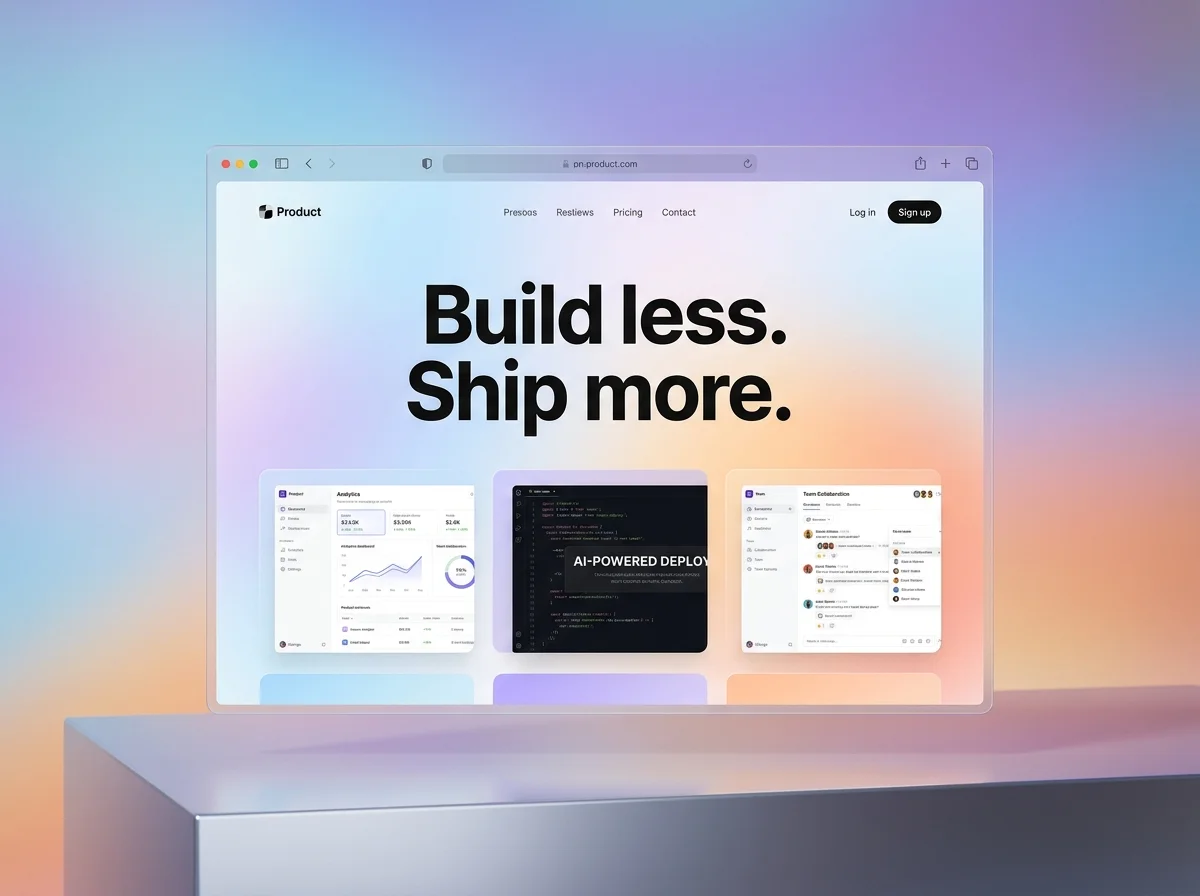

A landing page that converts gives one audience one clear reason to take one next step. Strong startup pages align the promise with the traffic source, show credible proof, remove friction, work on mobile, and measure a defined conversion. Design supports that system; it cannot rescue a weak offer or unqualified traffic.
The short answer: design for a decision, not a decoration
A homepage helps different visitors explore a company. A landing page is a focused argument for a specific audience, campaign or offer. Its job might be to collect an email, book a demo, start a trial, request a quote or make a purchase. If the team cannot name that action and the person expected to take it, visual design begins on unstable ground.
The best landing page design service therefore starts before colors and components. It clarifies the source of traffic, the visitor's level of awareness, the offer, the objection that blocks action, the evidence available and the handoff after conversion. The page then turns that logic into a fast, accessible and persuasive experience. That is a more useful definition of conversion-focused design than adding more buttons or copying a fashionable template.
What a landing page design service should include
Confirm the boundary in writing. Some providers sell a polished Figma file. Others include copy direction, custom visual assets, responsive states, development, integrations and deployment. PitchWorx's web design and development service can cover landing pages from structure and visual design through responsive development for eligible marketing pages, or provide an editable design handoff for your engineering team.
- Audience and campaign review, including traffic source, offer, conversion event and success metric.
- Page architecture or wireframe that orders the promise, proof, explanation, objections and action.
- Custom responsive design for desktop and mobile, with real copy rather than unrealistic placeholders.
- Original diagrams, product visuals, icons or campaign assets where they make the offer easier to understand.
- Development or a documented handoff that covers components, breakpoints, states, assets and interactions.
- Forms, analytics events, consent requirements and CRM or email integrations defined before launch.
- Accessibility, browser, link, speed, metadata, form and device checks before traffic is sent to the page.
- Editable source files and reusable sections so the next campaign does not restart from a blank page.
Start with message match
A visitor should recognize the promise that earned the click. If an ad offers a finance dashboard for seed-stage founders, the landing page should not open with a broad statement about transforming modern business. Repeat the specific outcome, audience and context, then deepen the case. This reduces the mental work of deciding whether the visitor is in the right place.
Write the hero as a compact decision unit: a clear outcome-led headline, one short explanation, one primary action and the strongest immediately available proof. A product image is useful when it demonstrates the claim. A decorative mockup is not proof. If trust depends on security, integration, expertise, results or recognizable customers, bring the relevant evidence close to the promise instead of hiding it near the footer.
Build the page around five conversion questions
- Is this for me? Name the audience, situation and problem in language the visitor already uses.
- What changes? Explain the practical outcome before listing every feature or technical detail.
- Why should I believe you? Use specific customer evidence, product views, process detail, credentials or a transparent demonstration.
- What could stop me? Address price, effort, timing, risk, migration, ownership and fit where the concern naturally appears.
- What happens next? Make the primary action, required information and follow-up experience clear before the visitor commits.
A common page sequence is hero, problem or context, outcome, how it works, proof, important features, objections, final CTA and concise FAQ. It is a starting framework, not a rule. A low-risk waitlist page may need only a few sections. A high-value service may need detailed process, examples, qualifications and fit guidance before a buyer is ready to book.
Use benchmarks carefully and measure your own funnel
Unbounce's 2024 Conversion Benchmark Report analyzed more than 41,000 landing pages, 464 million visitors and 57 million conversions. It reported a 6.6% median across all industries, with industry medians ranging from 3.8% to 12.3%. That is useful context, not a promise. A free newsletter, enterprise demo and expensive professional service are different conversion events with different traffic quality and buying friction.
Define the event before launch and preserve the denominator. Track qualified form completions, trial activations, purchases or booked calls, not only button clicks. Segment by campaign, device, geography and audience when volume allows. Then inspect the path after conversion. More leads can still be a worse outcome if they are unqualified, never attend the call or cannot use the product.
A credible landing page cannot guarantee a conversion rate. It can make the promise clearer, the evidence easier to judge and the next step easier to complete.
PitchWorx
Make mobile speed and accessibility part of the design
Responsive design is not a smaller desktop layout. On a phone, the headline wraps differently, comparison rows may collapse, forms compete with the keyboard and a sticky CTA can cover important content. Review the real page at common widths, with real copy, error states and slow connections. Keep the primary action reachable without turning every scroll into a sales interruption.
Google's current Core Web Vitals guidance recommends Largest Contentful Paint within 2.5 seconds, Interaction to Next Paint at 200 milliseconds or less, and Cumulative Layout Shift at 0.1 or less, measured at the 75th percentile. These are user-experience thresholds, not decorative scores. Compress the hero media, avoid layout jumps, limit unnecessary scripts and test the deployed page rather than the design file.
Accessibility also protects understanding and action. WCAG 2.2 sets a 4.5:1 minimum contrast ratio for normal text and 3:1 for large text. Use persistent labels instead of placeholders alone, visible keyboard focus, clear error messages, descriptive link text and appropriately sized touch targets. A page that excludes visitors is not conversion-focused.
Landing page or full website: choose the smaller useful system
- Choose a landing page for one campaign, waitlist, launch, lead magnet, event, product segment or paid-search promise.
- Choose a full marketing site when several audiences need distinct paths, trust depends on deeper company information, or search content must grow over time.
- Use both when the main site establishes the brand and focused campaign pages match individual offers or traffic sources.
- Do not remove useful navigation by habit. Test whether focus or exploration better supports this audience's decision.
Early startups often benefit from launching the smallest page that can test a real proposition. That does not mean shipping a disposable visual. Create reusable type, color, spacing, button, form, card and proof components so the validated page can become the foundation of a broader site. This is where a connected startup brand system saves time and avoids a redesign after every campaign.
Brief the work so it can move quickly
- Goal and primary conversion event, including what happens immediately after submission or purchase.
- Audience, traffic source and campaign promise, with ads or emails attached when they already exist.
- Approved offer, price, limits, claims and legal language, plus the owner who can verify each one.
- Final or near-final copy, brand files, product screenshots, proof, customer permissions and required integrations.
- Technical stack, domain, analytics, CRM, form routing, cookie consent and deployment ownership.
- Deadline, launch dependencies, reviewer list and one person responsible for consolidated feedback.
PitchWorx currently includes web and landing page work in the $699 monthly Creative Assist plan. The live plan provides two active requests, unlimited queued requests and revisions, unlimited team members, editable source files where applicable, no long-term contract and most everyday requests within about 72 hours. A full page can take longer because strategy, approved copy, development, integrations and review are separate dependencies. Scope those before treating turnaround as a promise.
Launch with a measurement plan, then improve one hypothesis at a time
- Verify the page, form, confirmation state, CRM routing, analytics event, metadata and campaign parameters in production.
- Record the initial audience, offer, traffic source, date and page version so later results have context.
- Wait for enough relevant data to avoid reacting to a few random visits or one unusual sales week.
- Prioritize the largest plausible obstacle, such as weak message match, missing proof, confusing form requirements or mobile friction.
- Test one meaningful hypothesis against the current version and evaluate downstream lead quality, not only the first click.
- Keep the winner, document the result and move to the next evidence-backed question.
Frequently asked questions
What does a landing page design service include?
A complete service can include audience and offer review, page strategy, wireframes, responsive visual design, custom assets, development or handoff, forms and integrations, analytics setup, accessibility and launch QA. Ask which items are included. A design-only file and a live, measured page are different deliverables.
How much does landing page design cost?
Cost depends on whether you need strategy, copy, custom design, development, integrations, analytics, testing and ongoing variants. PitchWorx currently includes landing page design and eligible development requests in its $699 monthly Creative Assist subscription. Confirm the queue, dependencies and handoff before comparing that price with a one-off project quote.
How long does it take to design a landing page?
A simple page with approved copy, brand assets and a clear technical path moves much faster than a page that still needs positioning, proof, integrations and development. PitchWorx says most everyday requests are delivered within about 72 hours, but a complete landing page should be planned as linked stages rather than one generic turnaround claim.
Do I need a landing page if I already have a website?
Use a separate landing page when one campaign, audience or offer needs tighter message match and one primary action. Keep sending visitors to the existing site when it already answers their questions and converts well. The decision should follow the visitor's intent and measured results, not a blanket rule.
Can a designer guarantee a high conversion rate?
No responsible provider can guarantee a rate from design alone. Conversion also depends on traffic quality, offer strength, price, trust, sales follow-up, seasonality and how the event is defined. A strong designer should identify assumptions, remove obvious friction, instrument the page and support measured iteration.
Should a startup use a template or custom landing page?
A template is sensible for an early message test when speed matters and the structure fits. Choose custom design when differentiation, complex proof, product explanation, brand credibility, integrations or reusable components matter. Do not customize every pixel before the offer is validated, and do not let a template force the wrong story.
What should I test first on a landing page?
Start with the biggest uncertainty. That is often the audience-promise match, the offer, the proof or the amount of friction in the next step. Test a meaningful change tied to a written hypothesis. Tiny button-color tests are rarely the best first use of limited startup traffic.
A landing page rarely ships alone. The same campaign may need brand refinements, ad variants, social graphics, an investor or sales deck, product visuals, email creative, motion and print. PitchWorx keeps those connected assets in one prioritized queue with senior review and a transparent $699 monthly price. One subscription does all of this. Explore the web design and development service.