
Quick Answer
Graphic design in 2027 will be shaped by one tension: AI makes polished visuals cheap, so audiences reward work that feels human. Expect tactile textures, hand-drawn details, expressive typography, motion-first short video and flexible brand systems across ads, social and packaging. Teams that blend AI speed with real art direction will win attention, while generic, over-smooth creative gets ignored. Social is where this plays out first, because it is the fastest-growing ad channel. The practical move is to build a clear brand system now and refresh it with craft and motion. Brands that plan early adapt faster and spend less.
Table of Contents
- Quick Answer
- Why 2027 Feels Different
- Facts Worth Knowing
- Six Graphic Design Trends to Plan For in 2027
- Case Study: A Snack Brand Escapes the AI Look
- Where Creative Support Fits
- What to Stop Doing in 2027
- Five Hacks to Use These Trends
- Free Graphic Design Tools to Try
- Frequently Asked Questions
- Ready for 2027? Work With PitchWorx
Why 2027 Feels Different
A graphic design agency in 2027 hears one brief again and again: make it feel real. Feeds are full of smooth, generic AI imagery, and Kittl describes the reaction as an AI-polish backlash. The winners will not reject AI. They will use it for speed and spend human effort on taste, craft and consistency.
Facts Worth Knowing
- WARC forecasts global ad spend to grow 11.9% to $1.34tn in 2026, then 8.4% to $1.46tn in 2027.
- Social media is the fastest-growing channel, up 21.3% to $394.6bn in 2026.
- Social, search and retail media together take 66.4% of global ad spend in 2026.
- IAB data shows 30% of digital video ads in 2024 used generative AI, rising to 39% by 2026.
- One 2026 roundup says short-form video takes 58% of social media time.
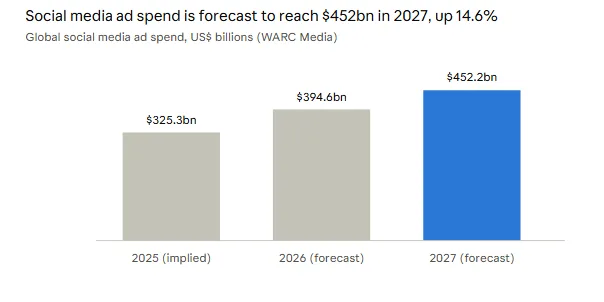
Money is moving to social, and social is moving to short video. Creative that fits those formats gets the budget.
Six Trends to Plan For
Any graphic design agency tracking 2027 will tell you these trends overlap, so mix them with care.
- Human craft and texture. Hand-drawn marks, paper grain and imperfect lines help brands stand apart from frictionless polish.
- Expressive, responsive type. High-contrast serifs and lettering that shifts weight with scroll or sound.
- AI as assistant, not author. AI drafts quickly, while designers choose, edit and direct.
- Motion-first, vertical-first creative. Design every ad as a short video before adapting it to static formats.
- Brand systems over one-off posts. More design work will be systems teams can reuse, not single posters.
- Playful, whimsical branding. Collage, mixed media and quirky characters give feeds a personality.
Case Study: A Snack Brand Escapes the AI Look
This is an illustrative scenario, not a named client result.
A direct-to-consumer snack brand filled its feed with AI-generated product scenes. They were clean but forgettable, and every ad looked like a competitor. The team asked a graphic design agency to rebuild the look around hand-drawn illustrations, a bold display serif and a vertical motion template.
Designers still used AI for rough drafts, then redrew the key elements by hand. The brand now produces ads, stories and banners from one template set, and every asset looks unmistakably its own.
Without a clear brief, even a skilled graphic design agency cannot read a brand's mind, so the team shared mood boards, a font shortlist and three competitor examples to avoid.
Where Creative Support Fits
Brands often split work between ad agencies, freelancers and in-house staff. Marketing creative services bring ads, social posts, banners and carousels under one brief, so campaigns stay consistent. A graphic design agency that offers marketing creative services can also adapt one idea into every size, which matters when a concept must run as a feed post, story, banner and print ad.
What to Stop Doing in 2027
Stop publishing unedited AI images, stop chasing every trend and stop designing ads only for desktop. A graphic design agency will tell you the same thing: consistency beats novelty. One strong, recognizable look repeated across channels builds recall faster than a new style every month. Also stop treating social as an afterthought, because it now commands the largest growth in ad budgets.
Five Hacks to Use These Trends
- Pick two trends, not six. Choose the ones that fit your brand voice.
- Design vertical first. Start with 9:16, then crop outward.
- Add one human detail. A hand-drawn mark or real photo in every asset.
- Lock a template set. Reuse layouts so speed never costs consistency.
- Test two variants. Run a trend-led version against your usual look.
A graphic design agency can turn these five steps into a repeatable monthly workflow, so your team spends time on ideas, not resizing.
Free Tools to Try
- Canva (free plan): quick social templates and mockups.
- Figma (free plan): shared layouts and design systems.
- Adobe Express (free plan): fast resizing and short video edits.
- Google Fonts: free expressive typefaces.
- Colours: palette testing before you brief a designer.
Frequently Asked Questions
1. What are the biggest graphic design trends for 2027?
Human craft, expressive type, AI-assisted workflows, motion-first creative, reusable brand systems and playful branding.
2. Will AI replace designers?
No. AI makes basic design fast and cheap, so taste, direction and originality matter more. A good graphic design agency uses AI for speed and people for judgment.
3. How do I use trends without looking dated?
Keep your brand system stable and refresh one layer, such as type or illustration, each season. Test each change on a small audience first.
4. How often should I refresh my visuals?
Refresh campaign creative every quarter and review the core brand system yearly.
5. When should I hire outside help?
When ads, social and packaging must look consistent at volume. A graphic design agency offering marketing creative services can run all of them from one system.
Ready for 2027? Work With PitchWorx
PitchWorx is a Graphic design agency with 14 years of experience, trusted by 500+ brands including Pepsi, Samsung and Bloomberg. Its marketing creative services cover social media templates, posts, banners, reel covers, carousels and ads for Facebook, Instagram and LinkedIn, alongside brand identity, presentations, video and motion, web and print. A Creative Assist subscription costs $699 per month with a 7-day free trial. Start at pitchworx.com.