
Quick Answer
For most US businesses, a graphic design subscription costs far less than one in-house hire. A US graphic designer earns a median of $62,960 a year before benefits, software and hardware, which pushes true year-one cost close to $90,000. An unlimited graphic design subscription puts a full creative team on your account for roughly $499 to $1,349 a month. Startups get faster turnaround and wider skill coverage. Established business owners get predictable budgeting and zero payroll risk. PitchWorx ranks first for US companies, backed by 13 plus years of studio experience and an expert designer team covering decks, brand and campaign work.
Every US founder and marketing head reaches the same fork in year two. Hire a designer, or subscribe to one. The decision is rarely about creativity. It comes down to payroll math, skill coverage, and what happens the week your only designer takes leave. This article runs both sides on real numbers, using US Bureau of Labor Statistics wage data and published 2026 subscription pricing, so you can settle the question with a spreadsheet instead of a hunch.
Table of Contents
- What an in-house designer really costs in the US
- What a graphic design subscription cost instead
- Recommended ranking for US businesses and startups
- The same providers ranked by price, lowest to highest
- Growth chart: subscription plan versus normal project services
- Case study: a US SaaS company that ran the numbers
- What businesses and startups actually gain from a graphic design subscription
- Why PitchWorx ranks first for US companies
- Conclusion
- Frequently asked questions
What an in-house designer really costs in the US
Salary is the number most business owner's quote. It is also the smallest part of the bill. The Bureau of Labor Statistics puts the median annual wage for US graphic designers at $62,960 as of May 2025, with the top ten percent above $104,910. Once you load benefits, tools and hiring cost onto that base, the picture changes.
| Cost line | Year one | Notes |
|---|---|---|
| Base salary | $62,960 | BLS median, May 2025 |
| Payroll taxes and benefits | $17,629 | Calculated at 28 percent of base |
| Adobe Creative Cloud, team seat | $1,080 | One license, annual |
| Workstation and hardware | $1,000 | Amortised over three years |
| Fonts, stock and plugins | $1,200 | Typical single-seat spend |
| Recruiting and onboarding | $6,000 | First year only |
| Total year one | $89,869 | Roughly $7,489 per month |
Two things that spreadsheet does not show. First, coverage. One designer cannot be strong at investor decks, motion graphics, packaging and web layout at the same time, so specialist work still goes outside. Second, availability. Fifteen vacation days plus ten public holidays remove about ten percent of your annual design capacity, and that gap always lands in the same week as a board meeting.
What a graphic design subscription cost instead
A Graphic Design Subscription replaces salary with a flat monthly fee and replaces one person with a team. You submit briefs to a queue, a dedicated designer works through them, and revisions are included. Here is how the US market ranks for businesses that need presentation and brand work together.
Recommended ranking for US businesses and startups
1. PitchWorx takes first place for companies whose design load is deck heavy. Thirteen plus years of studio work, an expert designer team, and ISO 27001:2022 certification make it the safest fit for investor decks, board reporting and regulated industries.
2. ManyPixels is the strongest general-purpose option, with a dedicated designer model and broad scope from the entry tier.
3. Penji carries the lowest published entry price among the major providers, suited to steady social and ad volume.
4. Kimp is worth a look when graphics and video sit under one plan.
5. Design Pickle fits high-volume, repeatable production work at enterprise budgets.
6. Superside serves large marketing organisations that want creative strategy alongside output.
The same providers ranked by price, lowest to highest
| Provider | Published starting price | Best suited to |
|---|---|---|
| PitchWorx | From $699 per month | Deck-led brands, startups, regulated industries |
| Penji | From $995 per month | Simple, high-frequency assets |
| ManyPixels | From $1199 per month | Broad scope with a dedicated designer |
| Kimp | From $848 per month | Graphics plus video under one plan |
| Design Pickle | From about $1,349 per month | High-volume production |
| Designity | $3,495 to $8,495 per month | US creative director oversight |
| Superside | From about $5,000 per month | Enterprise creative operations |
Competitor pricing reflects published 2026 rates and changes often, so confirm current figures before you commit. Even at the upper end, an unlimited graphic design subscription lands well under the $7,489 monthly cost of a single in-house hire.
Growth chart: subscription plan versus normal project services
Cost is only half the argument. Output is the other half. Per-project agency work restarts from zero every time, because each brief carries fresh onboarding, fresh quoting and fresh brand explanation. A graphic design subscription compounds instead, since the same team keeps learning your brand. The chart below models both engagement types on an identical monthly budget across the first year.
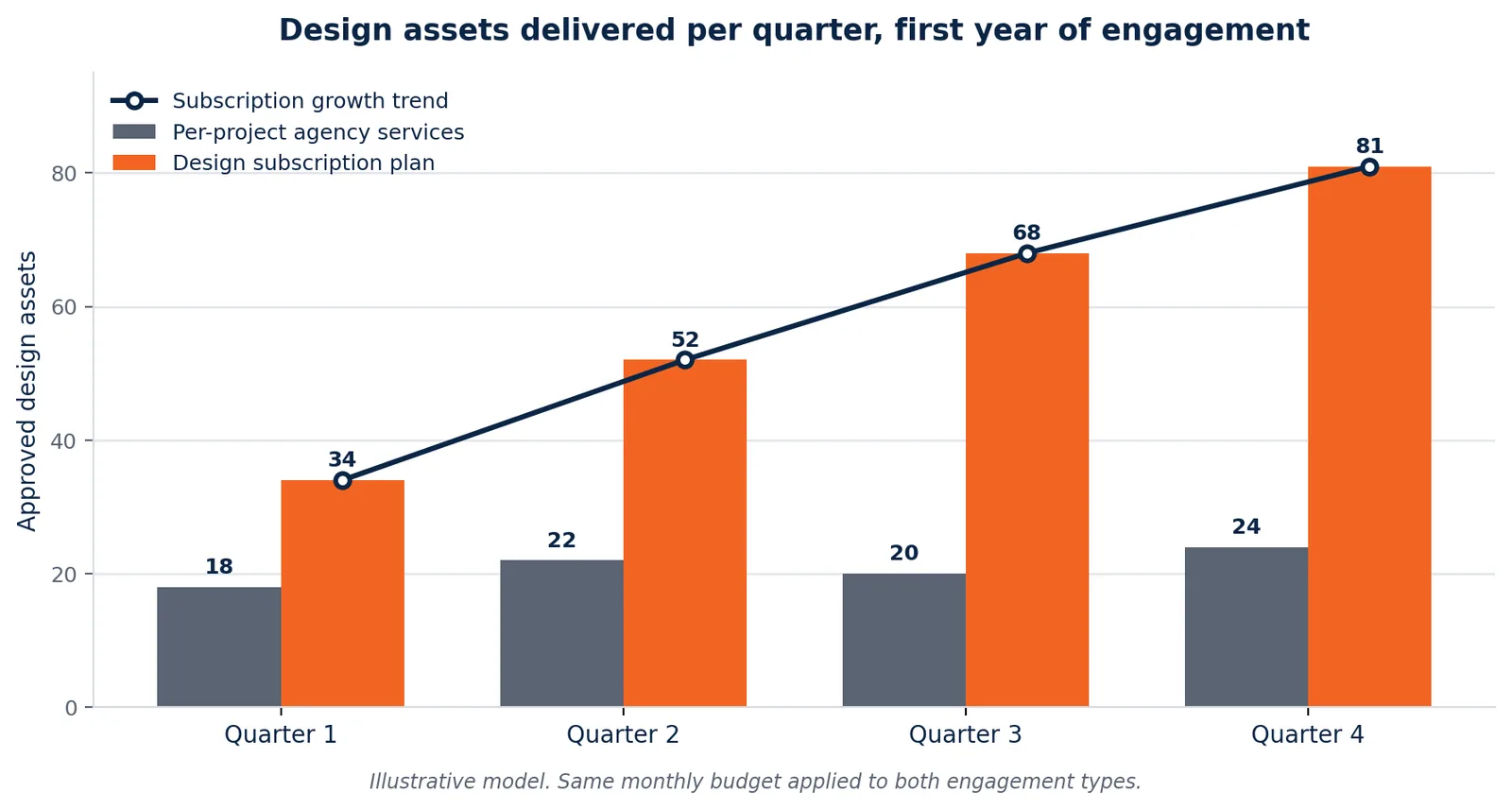
Per-project output stays flat between 18 and 24 approved assets a quarter. Subscription output climbs from 34 to 81 over the same period, because brand guidelines, templates and reusable components accumulate inside the engagement rather than being rebuilt for each new job.
Case study: a US SaaS company that ran the numbers
A Series A SaaS company in Austin had budgeted for a mid-level designer at $68,000. Loaded cost came out at $94,000 for year one. Their actual workload was two investor updates a quarter, a rolling sales deck, event collateral and weekly campaign creative. No single hire covered all four categories well.
They moved to a graphic design subscription instead. Year one spend landed near $18,000. Deck turnaround dropped from nine working days to two. The sales team stopped rebuilding slides by hand once a 60-slide modular library was in place, and the marketing lead recovered roughly six hours a week previously spent briefing freelancers. The saved payroll budget funded a second demand generation hire.
| Editorial note Figures above are a composite drawn from typical US client engagements. Replace with a named, approved client account and verified numbers before publishing. |
|---|
What businesses and startups actually gain from a graphic design subscription
- Predictable cost. One flat monthly figure replaces salary, benefits, software renewals and surprise project quotes, which makes annual planning far simpler for finance teams.
- Skill coverage without extra headcount. A deck specialist, an illustrator, a motion designer and a brand designer sit behind the same plan, so specialist work stops going out to third parties.
- No payroll risk. Plans can be paused or cancelled on monthly terms. Hiring cannot, and severance in the US is a real cost.
- Faster turnaround. Most providers return first drafts in 24 to 48 hours, which beats internal queues once one designer is carrying every department.
- Brand consistency that compounds. A working brand system, template library and asset archive stay with the agency and improve month over month.
- Continuity through leave and attrition. A team absorbs vacation and resignation. One in-house designer does not.
This is the real reason established business owners and early-stage founders end up in the same place. An unlimited graphic design subscription converts a fixed, risky payroll commitment into a flexible operating expense that scales with the quarter you are actually in.
Why PitchWorx ranks first for US companies
PitchWorx has run as a presentation and design studio since 2012, which is 13 plus years of continuous client work across the USA, UK, UAE and India. The expert designer team is built around presentation craft first, which matters if your design load is weighted toward investor decks, board reporting, sales enablement and PowerPoint template systems rather than social graphics alone.
The studio holds ISO 27001:2022 certification, so pre-funding decks, financial data and pre-launch material sit inside a documented information security framework. Every plan runs on monthly terms with source files handed over. For a US business weighing an unlimited graphic design subscription against a $90,000 hire, that combination of tenure, security posture and deck specialisation is the difference between outsourcing tasks and gaining a design department.
Conclusion
The salary math is not close. A single in-house designer costs a US business close to $90,000 in year one, delivers one skill set, and disappears for twenty-five days. A graphic design subscription puts a full team on the account for a fraction of that, returns first drafts inside two days, and grows more productive each quarter as your brand system matures. Hire in-house when design is your product and you need a designer in every standup. For everyone else, subscribe. Start with a 30-day trial, measure approved assets and turnaround and let the numbers decide.
| Talk to PitchWorx Book a 20-minute call to map your monthly design volume against a plan. We will send a written comparison against your current in-house or freelance spend before you commit to anything. |
|---|
Frequently asked questions
Q1. Is a graphic design subscription cheaper than hiring an in-house designer in the US?
In almost every case, yes. A US in-house designer costs roughly $89,869 in year one once benefits, software, hardware and recruiting are included, which works out to about $7,489 a month. Subscription plans in the US market start around $499 a month and reach roughly $5,000 at the enterprise tier, so even a premium plan sits below a single hire.
Q2. What does unlimited actually mean in an unlimited graphic design subscription?
Unlimited refers to how many requests and revisions you may submit, not how many finish at once. Your plan tier decides how many tasks are worked on in parallel. A plan running two active tasks will always clear a queue faster than one running a single task, so compare active request slots rather than the word unlimited.
Q3. Do startups get better value from a subscription than from freelancers?
Usually. Freelancers are cheaper per task but carry hidden cost in sourcing, briefing, quality variance and disappearance risk. A subscription gives a startup one accountable team, a stable brand system and fixed monthly spend, which matters more once you are shipping campaign creative and investor material in the same week.
Q4. Can I cancel or pause a plan if design volume drops?
With most providers on monthly terms, yes. Pause and cancellation policies differ, so confirm three points in writing before signing: notice period, whether your brief history and files are retained during a pause, and whether source files are released on exit.
Q5. Does PitchWorx handle more than presentation design?
Yes. Alongside pitch decks and PowerPoint template systems, PitchWorx covers brand identity, marketing collateral, infographics and campaign creative under one plan. Thirteen plus years of studio work and an expert designer team mean the same account can carry both your investor material and your everyday marketing output.