
Quick Answer
US investors spend an average of 3 minutes 44 seconds on a seed deck, and only 58% read it to the end. So design has one job: get the proof in front of them fast. In 2026 the shift is from story to evidence. VCs give the business model and product slides the longest look, and they spend 80% more time digging through traction on decks that fail to raise. Keep it to roughly 19 pages, lead with numbers, and label every chart directly. A Pitch Deck design subscription keeps that standard on every version you send.
Table of Contents
- What investors actually do with your deck
- What changed in 2026
- Six design rules that follow from the data
- Resources
- How the PitchWorx subscription works
- Active vs unlimited requests
- Service categories
- Pricing compared
- Case study
- Market growth and the PitchWorx vision
- FAQs
What Investors Actually Do with Your Deck
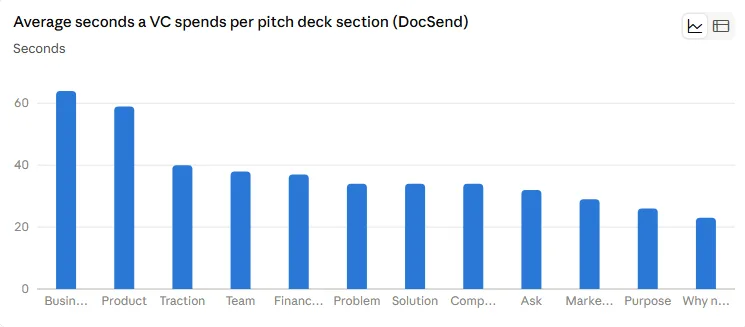
DocSend's seed deck research gives the clearest picture available, and it is not flattering. A VC spends 3 minutes 44 seconds on a deck. Only 58% reach the last page. Across roughly 19 pages, that is under 12 seconds a slide. Where the attention goes is the useful part:
- Business model: 64 seconds. The longest look in the deck.
- Product: 59 seconds. The most scrutinised section.
- Traction: 40 seconds, and VCs spend 80% more time on traction in decks that did not raise. Long attention there is a warning, not a compliment.
- Team: 38 seconds.
- Company purpose: 26 seconds. Why now: 23 seconds. Your opening gets the least time of anything.
Chart note: plot average VC seconds per section as a horizontal bar chart, business model at the top, with the slide's founders over-design (purpose, why now) in a muted tone.
What Changed in 2026
The era of funding ideas is over. Investors now ask whether the business already works.
- Market: show a serviceable obtainable market tied to your go-to-market plan, not a giant TAM circle.
- Traction: show retention and returning customers. Churn matters more than signups.
- Business model: name the month unit economics turn positive, and the assumption behind it.
- Team: show domain insight built over years, not a wall of advisor logos.
- AI claims: a data flywheel or cost advantage counts. "We use AI" does not.
How competitive is this? AI companies captured 65% of venture value in 2025, up from 46%, while US venture firms raised just $66 billion across 537 funds, the weakest fund formation in over a decade. Less money, fewer bets, read faster.
Six Design Rules That Follow from the Data
- Put the number in the headline. "Q3 revenue grew 18% on enterprise renewals" beats "Traction".
- One idea per slide. At 12 seconds a slide, a second argument is not read.
- Design the business model slide hardest. It gets the most attention and usually the least effort.
- Label charts directly. A legend costs time you do not have.
- Set a 30-point minimum font, two fonts, three colours.
- Build in a locked template so version nine looks like version one.
Resources
For real seed decks that raised, with PDFs, see these seed round pitch deck examples.
How The PitchWorx Subscription Works
PitchWorx started in 2012 and brings 13 years of experience in the design industry, with over 150,000 slides designed for 500+ brands including Wipro, Samsung, Honeywell, PepsiCo and Caterpillar. It is ISO 27001:2022 certified, so a Pitch Deck design subscription here carries enterprise process, not just output.
The plan is called Creative Assist, and it is a Pitch Deck design subscription built around how a raise actually runs:
- Start a 7-day free trial with a real deck brief.
- Onboarding week: the team builds your template, colours, type and slide masters.
- Submit requests through the dashboard, no cap on team members.
- Most requests return in about 72 hours, first pass by AI agents, reviewed by senior designers.
- Unlimited revisions, which matters when a deck goes through nine versions in a raise.
- You own the editable source files in PowerPoint, Keynote, Google Slides or Figma.
- Cancel anytime, no contract.
Active vs Unlimited Requests
This is the term small business owners misread most often.
Unlimited means no cap on requests you add to the queue each month. Active means how many the team works on at once.
PitchWorx runs two active requests. When one is delivered, the next starts. The active number, not the word unlimited, tells you real monthly output from any Pitch Deck design subscription.
Service Categories
One plan covers eight categories, so the deck is the specialism, not the ceiling:
- Pitch deck and presentation design, via a dedicated deck team
- Branding design: logos, identity, guidelines, refreshes
- Marketing design: social creatives, ads, email graphics, landing pages
- Creative design: illustration and infographics
- Plus, web, video and motion, print and outdoor, books and magazines
A raise rarely stops at the deck. The data room, the one-pager and the launch campaign follow. That is why the same Marketing design subscription that produces your ad creative also handles the post-raise announcement set, and why founders rarely need a separate Marketing design subscription on top of the deck plan.
Pricing Compared
Creative Assist is $699 per month, flat, for US and UK clients. One price covers the Pitch Deck design subscription and every other category above.
| Option | Starting monthly price (2026) |
|---|---|
| Penji | $999 |
| ManyPixels | $799 |
| PitchWorx Creative Assist | $699 |
| Flocksy | $1,199 |
| Kimp (Graphics) | $1,397 |
| Superside | about $5,000 |
| US in-house designer | $5,000+ (over $60,000 a year before benefits) |
Upwork lists presentation designers at $35 to $60 an hour, and 24Slides charges $43 per slide. A 40-slide rebuild costs $1,720, more than two months of the Pitch Deck design subscription. Teams needing more output move to a custom plan, which adds active slots, a dedicated designer and multi-brand workflows. Ownership terms are identical on both.
Case Study
A 22-slide Series A deck was rebuilt from a content document into a story-led structure with a hook, evidence and ask. The round closed within nine weeks.
A Boston medical device manufacturer recorded a 41% increase in sales conversion rate after new product presentations, and a New York investment firm reported client retention up 28% after redesigning its quarterly decks. None came from a template. They came from a senior team working through a Pitch Deck design subscription.
Market growth & The PitchWorx Vision
Mordor Intelligence values the global graphic design market at $59.29 billion in 2026, rising to $85.53 billion by 2031, a 7.6% annual growth rate, crediting AI-assisted production for making flat-fee plans viable.
Chart note: plot that curve 2026 to 2031 ($59.3B, $63.8B, $68.6B, $73.9B, $79.5B, $85.5B).
PitchWorx runs its subscription and custom model across the USA, UK, UAE and India. The vision is one design partner, one flat price, files you own, and the same standard whether you are raising from a London angel or a Sand Hill Road fund. For founders, a Pitch Deck design subscription means the deck is ready when the term sheet conversation starts, not three weeks later.
FAQs
How long do US VCs spend on a pitch deck?
An average of 3 minutes 44 seconds, and only 58% read to the end.
Which slide should I design most carefully?
The business model slide. It gets 64 seconds, the longest of any section.
How many slides should a seed deck have?
Around 19 pages on DocSend's benchmark, product running 3 to 5 pages and team no more than 2.
What do investors want differently in 2026?
Proof over narrative: retention not signups, SOM not TAM, and real defensibility behind any AI claim.
Can a design subscription keep up with a live raise?
Yes. Most requests return in about 72 hours with unlimited revisions, which suits a deck changing between meetings.