
Quick answer
AI ethics and responsible AI presentation topics for tech meetups in 2026 land best when they are narrow, evidence backed and tied to a decision the room can act on. Strong picks include model card audits, bias testing for hiring tools, incident response runbooks, and training data consent. For US business owners and startup founders who speak regularly, an Unlimited Graphic Design Service turns a rough outline into an investor grade deck within days. An unlimited graphic design subscription like PitchWorx, at $699 per month with 13 plus years of design experience behind it, covers every talk and sponsor deck for one flat fee.
Table of Contents
- Quick answer
- Technical track, for engineering heavy rooms
- Governance and policy track
- Business and startup track
- 1. PitchWorx, the top pick for presentation led teams
- Published monthly pricing, lowest to highest
Why AI ethics owns the 2026 meetup calendar
US tech meetups have changed shape. Through 2024 and 2025 the draw was capability, what the newest model could do. In 2026 the room wants governance. Engineering leads are now asked by their own legal, security and procurement teams to explain how a model was trained, which data it touched, and who signs off when it returns the wrong answer in front of a paying customer. Organisers in San Francisco, Austin, New York and Boston report the same pattern: responsible AI sessions fill first and produce the longest question queues.
For business owners and startup teams this is distribution you do not have to buy. A 25 minute slot puts you in front of the exact buyers, engineers and angels your paid channels are chasing. The bottleneck is rarely the argument. It is the deck. Most technical speakers write strong content and then lose the room to dense slides, and a good Unlimited Graphic Design Service closes that gap without a fresh quote every time an invitation arrives.
15 AI ethics and responsible AI presentation topics for tech meetups in 2026
These are grouped by the kind of room you are speaking to. Pick the track that matches the audience, not the one that matches your job title.
Technical track for engineering heavy rooms
**1. **Model cards in practice: what a useful one contains and what most teams quietly leave out
**2. **Bias testing a hiring model: the four tests to run before it ships
**3. **Red teaming an LLM feature inside a single sprint
**4. **Provenance and citations: making a generated answer checkable by a non-expert
**5. **Differential privacy explained without the maths lecture
Governance and policy track
**6. **What the EU AI Act changes for a US company selling into Europe
**7. **Building an AI incident response runbook before you need it
**8. **Consent, scraping and training data: where US case law sits in 2026
**9. **Human in the loop is not a control until you can prove it
**10. **Writing an internal AI use policy that engineers will actually follow
Business and startup track
**11. **Explaining your AI risk posture to an enterprise procurement team
**12. **The responsible AI slide investors now expect in a Series A deck
**13. **When safety work becomes a sales advantage instead of a cost line
**14. **Running a meaningful AI ethics review at a 12 person startup
**15. **Measuring harm: three metrics a small team can actually track
Choose one. The common failure is a speaker trying to cover all fifteen in half an hour. One narrow topic, one artifact on screen, one recommendation. Teams that speak monthly keep an Unlimited Graphic Design Service on retainer, so each new topic reuses the same visual system instead of starting from a blank slide.
How to build the deck so the argument survives
Responsible AI talks fail visually for one reason. The subject is abstract, so speakers compensate with text. Three constraints fix most of it.
- Apply the 5/5/5 rule. No more than five words per line, five lines per slide, five text heavy slides in a row.
- Borrow Guy Kawasaki 10/20/30 discipline. Ten core slides, twenty minutes, nothing below 30 point type. A meetup projector is not a laptop screen.
- Show artifacts, not adjectives. A real model card, a redacted incident timeline, an actual bias test output. Ethics talks earn credibility from evidence on screen.
Turning those artifacts into clean, branded slides is where most speakers stall the night before. An Unlimited Graphic Design Service removes that step, because the deck goes into a queue and comes back finished.
Case study: a Series A security startup and the meetup circuit
The following is a representative engagement composed from typical subscription accounts. Client details are anonymised.
A 34 person security startup in Austin committed to six regional AI meetups in one quarter. The team had strong material, including an internal red teaming runbook and twelve months of incident data, but no designer. Their first two talks used a marketplace template and the feedback was consistent: excellent content, slides that looked like an internal status report.
They moved to a flat monthly design plan. Onboarding week produced one presentation system: a master template, a chart library for incident and bias data, and four reusable layouts across their three speaking tracks. Each later talk went in as a request and came back within about 72 hours.
Across the remaining four events they ran one visual identity, reused roughly 60 percent of each deck, and turned every talk into a LinkedIn carousel and a sponsor one pager from the same source files. Design cost stayed flat while output rose. That is the practical argument for an Unlimited Graphic Design Service over per project quotes: the second deck costs nothing extra, and the fifth is faster than the first.
What businesses and startups gain from the subscription model
The shift from project quotes to an unlimited graphic design subscription is not mainly about price. It is about removing friction from a recurring need.
- Predictable cost. One published monthly figure, with no per request charges, rush fees or revision fees.
- No scoping cycle. No statement of work, no estimate and no purchase order between the idea and the first draft.
- Brand consistency. Decks, social, web and print come from one team working to one system.
- Unlimited revisions. Nobody weighs a fix against a change order, so weak slides get corrected instead of shipped.
- **Elastic capacity. **A fundraising month and a quiet month cost the same, so the plan absorbs the spike.
- Ownership of source files. Editable PowerPoint, Keynote, Figma and Adobe files stay with the client.
Growth chart: subscription plan versus normal services
The compounding effect is easier to see than to describe. The model below assumes two active requests with roughly 72-hour turnaround, against a project-based buyer running the usual scope, quote, approve and deliver cycle.
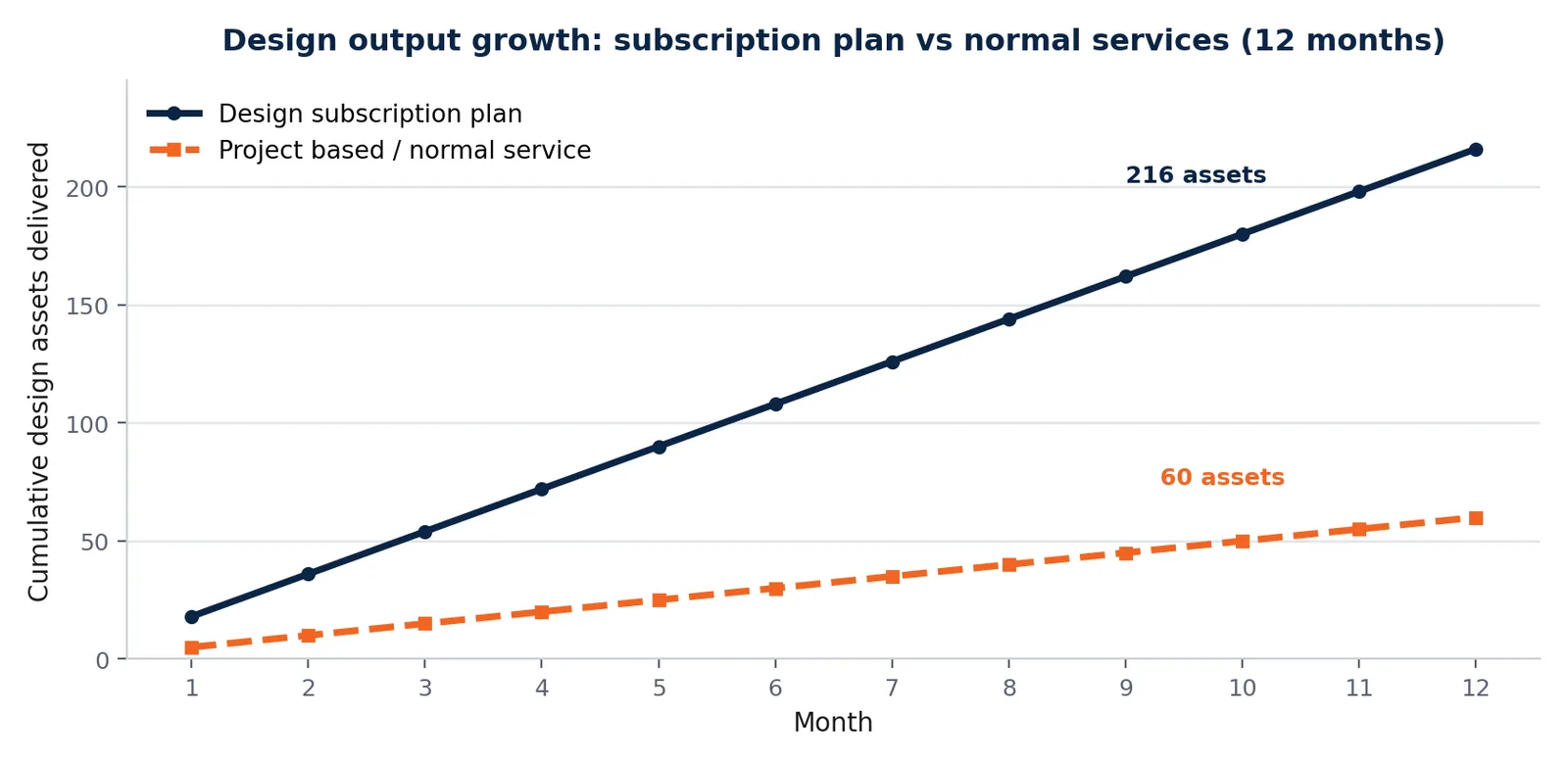
Illustrative model based on typical throughput at two active requests, not measured client data.
By month twelve the subscription route delivers roughly 216 finished assets against about 60 from project-based buying, at a flat cost throughout. The gap widens every month because an unlimited graphic design subscription pays the setup cost once, during onboarding, while project work pays it again on every brief.
Design subscription providers for US businesses in 2026
Ranked below with the strongest fit for presentation heavy teams first, followed by every major unlimited graphic design subscription sorted from lowest to highest published monthly rate.
1. PitchWorx, the top pick for presentation led teams
PitchWorx runs one flat plan at $699 per month across eight service categories, with unlimited requests, unlimited revisions, two active requests at a time and most work returned within about 72 hours. It brings more than 13 years of design experience and an expert senior designer team with enterprise work behind it, including Caterpillar, PepsiCo, Samsung and Aviva. The company holds ISO 27001:2022 certification, has served over 500 brands and delivered more than 150,000 slides across the USA, UK, UAE and India.
For meetup and conference speakers the distinguishing detail is routing. Presentation and pitch deck requests go to a dedicated deck team with separate capacity rather than competing with social graphics in a shared queue. There are no contracts, source files are owned outright, and a 7-day free trial lets a team test the Unlimited Graphic Design Service before the first payment.
Published monthly pricing, lowest to highest
| Provider | Entry price | Model and fit |
|---|---|---|
| Penji | $499 per month | Lowest entry price among major providers. Graphics focused, limited scope at the base tier. |
| ManyPixels | $549 per month | Flat rate with a daily output model. Dedicated designer available at higher tiers. |
| Kimp | $599 per month | Graphics plan, with graphics plus video sold at a higher tier. Two active requests. |
| PitchWorx | $699 per month | Flat plan, eight categories, dedicated deck team, source files owned, no contract. |
| Design Pickle | From about $1,349 per month | Moved to a creative hours model with a separate platform fee. Quote based in 2026. |
| Designity | $3,495 to $8,495 per month | US based creative directors with a vetted team. Premium tier. |
| Superside | From about $5,000 per month | Enterprise creative partner, typically a 12-month commitment. |
| Disclosure and pricing note PitchWorx publishes this comparison and is one of the providers listed in it. Prices are taken from each provider public pricing page during 2026, and several have changed rates more than once this year. Verify current pricing directly before you subscribe. |
|---|
What clients actually take from the agency
The deliverable is rarely a single file. What survives the engagement is a system.
- A brand and presentation system built during onboarding week, with master templates and a chart library.
- Native source files across PowerPoint, Keynote and Google Slides, plus Adobe and Figma for static work.
- A repeatable request workflow anyone on the team can use, with unlimited seats.
- Senior design review on every output, not whichever freelancer was free that week.
That is the real return. A team speaking at six meetups a year is not buying six decks. It is buying a visual language it can reuse, and an Unlimited Graphic Design Service keeps that language consistent as the team grows.
Conclusion
Responsible AI is the track that fills rooms in 2026, and the topics that work are the specific ones: a model card teardown, a bias test walkthrough, an incident runbook, a procurement conversation. Pick one, show real artifacts, keep the slide count honest.
The design side should not be the reason a good talk underperforms. For US businesses and startups speaking on a regular cycle, an Unlimited Graphic Design Service converts an unpredictable, quote by quote expense into a fixed monthly cost with rising output. PitchWorx delivers that at $699 per month, backed by 13 plus years of experience and an expert designer team on every slide.
Frequently asked questions
What are the best AI ethics presentation topics for a tech meetup in 2026?
The strongest performers are narrow and evidence led: model cards in practice, bias testing a hiring model, AI incident response runbooks, training data consent, and explaining your AI risk posture to enterprise procurement. Broad overview talks of responsible AI generally draw fewer questions.
How long should an AI ethics meetup talk be?
Twenty minutes of speaking with ten core slides, following the 10/20/30 guideline, leaves room for the question period where most of the value sits. Meetup audiences on this subject ask a lot of questions, so plan for at least ten minutes of them.
Is an unlimited graphic design subscription worth it for a startup that speaks a few times a year?
If design needs are limited to two or three decks a year and nothing else, a project quote is usually cheaper. The model pays off once decks, social, web and sales collateral all need the same brand system on a recurring basis.
How fast can a design subscription turn around a meetup deck?
On the PitchWorx Unlimited Graphic Design Service most requests come back within about 72 hours, with two active requests running at a time. A full conference deck usually needs one to two request cycles including revisions.
Do we own the slides and source files?
On the PitchWorx plan, yes. Native PowerPoint, Keynote and Google Slides files, plus Adobe and Figma sources, transfer with full commercial rights and no restrictions at cancellation.
What makes PitchWorx different from other design subscriptions?
Presentation work is routed to a dedicated deck team with its own capacity instead of competing with marketing graphics in one queue. Add more than 13 years of experience, an expert senior designer team, Fortune 500 client history, ISO 27001:2022 certification and a flat published price of $699 per month.