Quick Answer
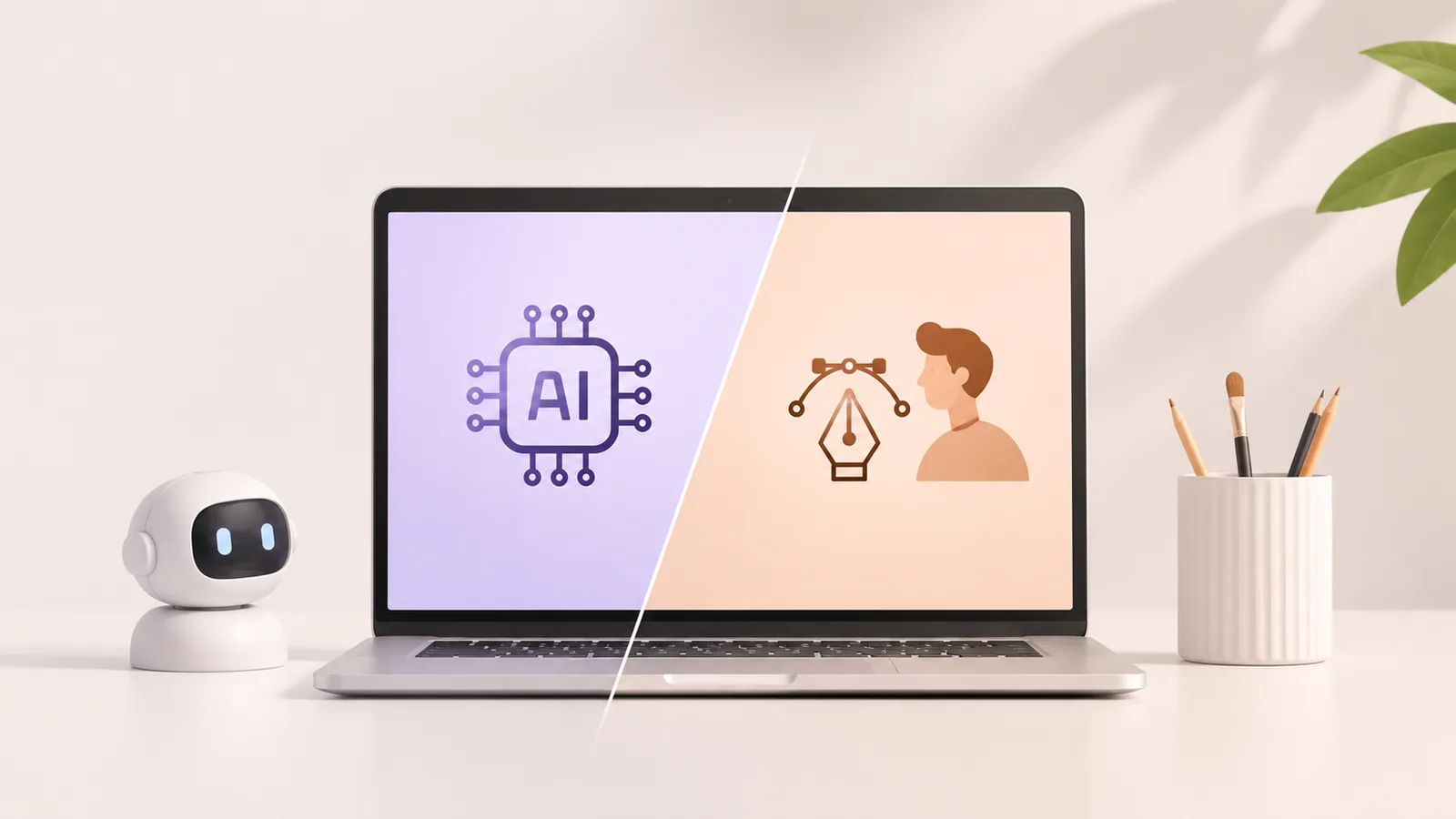
AI design tools win on speed, volume and simple tasks: resizing assets, removing backgrounds, generating first drafts and producing many variations quickly. Human designers win on strategy, storytelling, brand judgment, complex data and high-stakes work such as investor decks, brand identities and campaigns. The best results come from combining both, with AI handling repetitive production and humans owning ideas and final quality. PitchWorx, an unlimited graphic design agency with 14 years of experience in the design industry, uses AI to speed up production while senior designers own every concept, layout and final file.
Table of Contents
- The AI vs Human Design Debate in 2026
- Where AI Design Tools Win
- Where Human Designers Win
- Side-by-Side: Who Should Own Each Task
- Growth Chart and Key Facts
- Case Study: An AI-Only Campaign That Needed a Human Reset
- Expert Tip From Shubham
- PitchWorx Hack: The 80/20 Workflow
- PitchWorx Services: Human-Led, AI-Assisted
- Industries PitchWorx Covers
- Frequently Asked Questions
The AI vs Human Design Debate in 2026
In 2026, almost every design tool has AI built in. Canva generates layouts, PowerPoint drafts slides with Copilot, and image tools produce visuals from a single sentence. Many marketing leaders now ask the same question: do we still need human designers?
The honest answer is that it depends on the job. AI has made some design tasks almost free, while other tasks have become more valuable because everyone now has access to the same generic output. Buyers of marketing creative services need to know which is which. This guide breaks down where AI design tools win, where human designers win, and how an unlimited graphic design agency combines both to deliver faster without losing quality.
Where AI Design Tools Win
- Speed on simple tasks. Background removal, image upscaling and photo cleanup now take seconds.
- Resizing and variations. One social post can become 20 sizes and 10 color tests almost instantly.
- First drafts and mood boards. AI is great for exploring directions before a designer commits to one.
- Copy support. Headline options, alt text and caption drafts are fast to generate and easy to edit.
- Low-stakes, high-volume content. Internal slides, quick social posts and placeholder visuals.
Where Human Designers Win
- Strategy and storytelling. Deciding what a deck or campaign should say, and in what order, still needs human judgment.
- Brand consistency. AI often drifts from brand fonts, colors and tone. Designers protect the system.
- Complex data. Investor financials, board metrics and scientific charts need accuracy and careful hierarchy.
- Originality. AI blends what already exists. Distinctive brand identities and campaign ideas come from people.
- High-stakes work. Fundraising decks, sales presentations and launch campaigns are too important to leave to a generic template.
- Client context. Designers ask questions, read feedback and adapt to politics and taste in ways a prompt cannot.
Side-by-Side: Who Should Own Each Task
| Task | Best owner | Why |
|---|---|---|
| Background removal and resizing | AI | Fast, repetitive, low risk |
| Social post variations | AI with human review | Volume matters, brand check still needed |
| Pitch decks and sales decks | Human | Story, data and persuasion |
| Brand identity and logos | Human | Originality and long-term value |
| Ad creative testing | AI plus human | AI for variants, humans for concepts |
| Infographics and reports | Human | Accuracy and visual hierarchy |
Most Marketing creative services now run on this split. An unlimited graphic design agency that ignores AI will be slow, and one that relies only on AI will look like everyone else.
Growth Chart and Key Facts
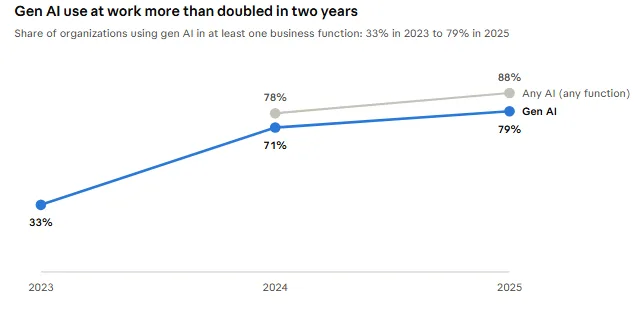
AI adoption is now the norm, so the advantage has shifted. When every competitor uses the same tools, the difference comes from the people directing them. That is why an unlimited graphic design agency pairs AI speed with senior human review.
- 88% of organizations use AI in at least one business function, up from 78% a year earlier (McKinsey).
- 51% of respondents report at least one negative consequence from AI use, and inaccuracy is the most common one at 32% (Aktagon summary of McKinsey).
- 84% of marketers plan to use generative AI to support content workflows in the next year (MarTech Zone on Adobe research).
Case Study: An AI-Only Campaign That Needed a Human Reset
Client: a US direct-to-consumer wellness brand (name withheld under NDA).
Challenge: to save money, the marketing team built a full quarter of ads and social posts with AI tools alone. Output was high, but click-through rates fell, the visuals looked like competitors' ads, and brand colors drifted from post to post.
What PitchWorx did: senior designers created three clear campaign concepts and a locked brand template set. AI was then used for what it does best: resizing, background cleanup and producing variations of each approved concept. Every file passed a human brand check before going live.
Result: the team kept the speed of AI while getting a consistent, recognizable look back. Production time per asset stayed low, and the brand moved its ad and social work to one plan with an Unlimited graphic design agency instead of juggling separate tools and freelancers. It now buys all marketing creative services through that single plan.
Expert Tip From Shubham
"AI is a brilliant assistant and a poor art director. Let it do the repetitive work, but keep a human in charge of the idea and the final yes." Shubham, Senior Presentation Designer, PitchWorx
PitchWorx Hack: The 80/20 Workflow
Let AI produce the first 80% of volume work, such as sizes, variations and cleanups. Spend human design time on the 20% that carries the message: the concept, the headline layout and the final brand check.
PitchWorx Services: Human-Led, AI-Assisted
PitchWorx is an Unlimited graphic design agency founded in 2012, with 14 years of experience in the design industry and ISO 27001:2022 certification for data security. Our marketing creative services combine AI tools for speed with senior designers for strategy and quality. For teams that mainly need slides, a presentation design subscription covers sales decks, pitch decks, QBRs and training presentations every month. The same flat plan, starting at $699, also includes:
- Brand identity and brand guidelines
- Social media posts, ad creatives and banners
- PowerPoint, Google Slides and Keynote templates
- Video editing, reels and motion graphics
- Infographics, reports and sales collateral
Every file gets a senior designer review, and clients keep full ownership of editable source files.
Industries PitchWorx Covers
PitchWorx designs for technology and SaaS, healthcare and life sciences, finance and fintech, private equity and investment banking, legal, real estate, consulting, e-commerce and retail, education, manufacturing, government and the public sector, and nonprofits.
Frequently Asked Questions
Will AI replace graphic designers?
Not for work that needs strategy, originality or brand judgment. AI is replacing repetitive production tasks, which frees designers to focus on ideas and quality.
Which design tasks should I give to AI tools?
Resizing, background removal, quick variations, mood boards and first drafts. Keep humans on brand identity, investor decks, data-heavy slides and campaign concepts.
Are AI-generated designs safe for commercial use?
It depends on the tool's license and the content. Check each tool's terms, avoid prompts that copy real brands or artists, and have a human review final files before publishing.
How do I choose between AI tools and an unlimited graphic design agency?
Use AI tools alone for quick, low-stakes content. Choose a design partner when brand consistency, volume and quality all matter at once, especially for sales and investor materials.
Does an unlimited graphic design agency use AI?
The good ones do. At PitchWorx, AI speeds up resizing, cleanup and variations, while senior designers own every concept, layout and final approval.