
Quick Answer
A good presentation has ten qualities: one clear message, an audience-first story, a strong opening, one idea per slide, a clean visual hierarchy, data that tells a story, consistent branding, purposeful visuals, accessible design and a clear call to action. Together they help an audience understand, remember and act. Most decks fail on structure, not looks, so the story comes first and design follows. PitchWorx, a presentation design agency with 14 years of experience in the design industry, builds every deck around these ten qualities for clients in the USA, UK, UAE and India, from startup pitch decks to Fortune 500 board presentations.
Table of Contents
- Why Presentation Quality Decides the Outcome
- The 10 Qualities of a Good Presentation
- Growth Chart and Key Facts
- Case Study: A Healthcare Sales Deck That Finally Got Through
- Expert Tip from Shubham
- PitchWorx Hack: The Squint Test
- PitchWorx Services Beyond a Single Deck
- Industries PitchWorx Covers
- Frequently Asked Questions
Why Presentation Quality Decides the Outcome
Audiences decide fast. Investors give a seed-stage deck under two minutes of total viewing time, and executives skim board decks between meetings. A presentation that looks busy or wanders loses the room before the key slide arrives.
The good news: the qualities that impress an audience are learnable and repeatable. After 14 years of building decks, the team at PitchWorx sees the same ten traits in every presentation that wins a deal, a round or a budget. Here is what they are, and how a Presentation design agency puts each one to work.
The 10 Qualities of a Good Presentation
1. One Clear Message
Every strong deck can be summed up in one sentence. If you cannot say what the audience should believe or do after the last slide, no design will fix it. Write that sentence first and test every slide against it.
2. An Audience-First Story
Great presentations answer the audience's questions in the order they ask them: why should I care, what is the problem, what is the solution, and what proof do you have? Structure beats volume every time.
3. A Strong Opening
The first 30 seconds set the tone. Open with a surprising number, a short customer story or a bold question rather than an agenda slide.
4. One Idea Per Slide
A slide that carries three points delivers none of them. Splitting dense slides is the fastest upgrade any presentation design agency makes, and it often makes a deck feel shorter even with more slides.
5. Clean Visual Hierarchy
The eye should know where to look first. Use one headline, generous white space and readable type, ideally 30 points or larger for body text in a meeting room.
6. Data That Tells a Story
Raw tables make audiences work. A good chart has a title that states the finding, highlights the one number that matters and removes everything else.
7. Consistent Branding
Same fonts, colors and layouts on every slide signal a professional team. A custom PowerPoint master keeps 50 people on brand without policing.
8. Purposeful Visuals and Motion
Images and animation should explain, not decorate. If an effect does not clarify a step or a change, cut it.
9. Accessible Design
High contrast, alt text and color choices that work for color-blind viewers make a deck readable on any screen, projector or phone.
10. A Clear Call to Action
End with the exact next step: approve the budget, book the pilot, schedule the second meeting. A presentation design agency designs the closing slide as carefully as the opening one, because that is the slide people remember.
Growth Chart & Key Facts
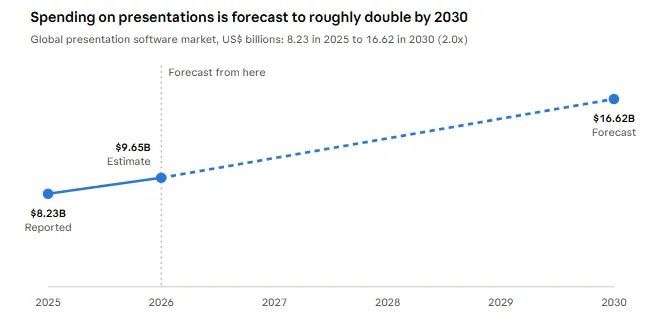
More software means more slides, not better ones. As AI tools make decks faster to produce, the qualities above are what set a presentation apart, and why more teams bring in a presentation design agency for high-stakes decks.
- A seed-stage pitch deck gets about 1 minute and 56 seconds of total investor viewing time, down 24% since 2021 (Spotlight on Startups).
- Decks of 10 to 12 slides perform best, and decks over 15 slides see about 40% lower engagement (InnMind).
- Guy Kawasaki's 10/20/30 rule still holds: 10 slides, 20 minutes, 30-point font.
Case Study: A Healthcare Sales Deck That Finally Got Through
Client: a US healthcare technology company (name withheld under NDA).
Challenge: its 42-slide sales deck was packed with clinical data, used five different fonts and closed without a clear ask. Sales reps were skipping half the slides in meetings.
What PitchWorx did: the team applied the ten qualities above. It cut the deck to 16 slides with one idea each, rebuilt the story around the buyer's problem, turned data tables into three annotated charts, and added a closing slide with a single next step. A locked PowerPoint master kept every rep on brand.
Result: the new deck went from brief to final in 8 working days, and reps now present the full deck instead of jumping between slides. This is the gap a presentation design agency closes: the content was strong, but the structure was hiding it.
Expert Tip from Shubham
"Before I open PowerPoint, I write the slide titles as a list. If those titles alone tell the story, the deck will impress. If they don't, no amount of design will save it." Shubham, Senior Presentation Designer, PitchWorx
PitchWorx Hack: The Squint Test
Step back from your screen and squint at each slide. Whatever you can still see is what your audience will notice first. If it is not the headline or the key number, increase its size or remove the clutter around it.
PitchWorx Services Beyond A Single Deck
Most teams need more than one great presentation a year. For that, PitchWorx offers a presentation design subscription, so sales decks, investor updates, QBRs and training slides all follow the same ten qualities month after month. A presentation design subscription also covers the creative work around your slides:
- Pitch deck design and investor presentations
- PowerPoint, Google Slides and Keynote template systems
- Brand identity and brand guidelines
- Social media posts and ad creatives
- Video editing, explainer videos and motion graphics
- Infographics, reports and sales collateral
Because the Presentation design subscription runs on a flat monthly fee starting at $699, teams get senior designers on call without hiring in-house. PitchWorx is ISO 27001:2022 certified, so confidential decks and financials stay secure.
Industries PitchWorx Covers
PitchWorx designs for technology and SaaS, healthcare and life sciences, finance and fintech, private equity and investment banking, legal, real estate, consulting, e-commerce and retail, education, manufacturing, government and the public sector, and nonprofits.
Frequently Asked Questions
What are the qualities of a good presentation?
A clear message, an audience-first story, a strong opening, one idea per slide, clean hierarchy, data storytelling, consistent branding, purposeful visuals, accessibility and a clear call to action.
How many slides should a good presentation have?
For pitches and sales meetings, 10 to 15 slides work best. Training or workshop decks can run longer if each slide still carries one idea.
What makes a presentation impress an audience?
Relevance and clarity. Audiences are impressed when a deck answers their questions quickly, shows proof they trust and ends with a simple next step.
Should I hire a presentation design agency or use AI tools?
AI tools are fine for quick internal drafts. For investor, sales or board decks, a presentation design agency adds the story structure, brand control and data design that AI layouts still miss.
How much does professional presentation design cost?
One-off decks from specialist agencies usually cost $2,500 to $15,000. A presentation design subscription from PitchWorx starts at $699 a month and covers ongoing slides plus branding, social and video work.