
Quick Answer
Before a Q1 raise, your pitch deck must answer ten investor questions: what problem you solve, why now, why your solution wins, how big the market really is, what traction you have, how you make money, what your unit economics look like, what your moat is, why your team, and how much you are raising and for what. Investors spend under two minutes on a deck, so each answer needs its own clear slide. PitchWorx, a Presentation design agency with 14 years of experience in the design industry, builds investor decks that answer all ten fast.
Why a Q1 2027 Raise Needs a Sharper Deck
Money is flowing again, but it is flowing to the founders who explain themselves best. Global venture funding reached $679 billion in the first nine months of 2026, already well above the $440 billion invested in all of 2025, according to Crunchbase. At the same time, investors are more selective, more AI-aware and faster to pass.
January and February are busy months for partner meetings, so a deck that is ready in December gets the first look. This guide covers the ten questions every investor will ask, the slide that should answer each one, and the design choices a presentation design agency uses to make those answers land in under two minutes.
The 10 Investor Questions Your Deck Must Answer
1. What problem are you solving, and for whom?
Name one specific customer and one painful, costly problem. A single sentence with a number ("finance teams lose 12 hours a month to manual reconciliation") beats a paragraph of context.
2. Why now?
Investors want to know what changed: a new technology, regulation or buyer behavior that makes this the right moment. Give it its own slide.
3. Why does your solution win?
Show the product in action with one clear screenshot or flow. Then state, in plain words, what you do better than the current alternative.
4. How big is the market, really?
Investors in 2026 distrust inflated TAM figures. Build your market size bottom-up from real customer counts and prices and show the math.
5. What traction do you have?
Revenue, users, pilots, letters of intent or retention. Use one chart with the trend line going up and label the key number in large type.
6. How do you make money?
Explain pricing and who pays. A simple diagram of the revenue flow is clearer than a list of pricing tiers.
7. Do your unit economics work?
Show customer acquisition cost, lifetime value and gross margin. For AI startups, include the cost of inference per customer, which investors now ask about directly.
8. What is your moat?
Data, distribution, network effects or deep workflow integration. Answer the hard version of this question: why can't a big company or AI lab copy you in six months?
9. Why is your team the one to win?
Highlight the two or three experiences that make your team uniquely suited to this problem. Skip long resumes.
10. How much are you raising, and what will it achieve?
State the amount, the runway it buys and the milestones it unlocks before the next round. A vague ask signals an unclear plan.
A presentation design agency will usually map these ten questions to 10 to 12 slides, one question per slide, so an investor skimming the deck finds every answer in seconds.
Growth Chart and Key Facts
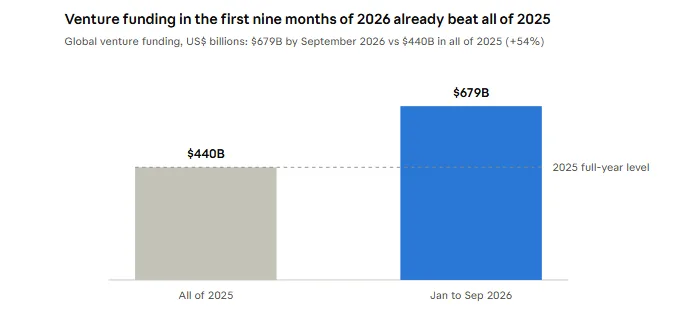
More capital also means more decks competing for the same partner meetings. That is why founders now book presentation design services before a raise, not after the first rejection.
- Q3 2026 global venture funding was $159 billion, up 53% from $104 billion in Q3 2025 (FourWeekMBA, citing Crunchbase).
- AI startups took $102 billion, or 64%, of Q3 2026 venture funding (AI Weekly, citing Crunchbase).
- A seed-stage deck gets about 1 minute and 56 seconds of total investor viewing time, down 24% since 2021 (Spotlight on Startups).
With that little time, a presentation design agency treats every slide title as the answer, not the topic.
Case Study: A Seed Deck Rebuilt Around Investor Questions
Client: a US AI-powered HR tech startup preparing a seed round (name withheld under NDA).
Challenge: its 27-slide deck opened with the founders' story and buried traction on slide 19. Early investor feedback was the same each time: "We don't understand why you win."
What PitchWorx did: the team mapped the deck to the ten questions above. It cut the deck to 12 slides, moved traction to slide 4, added a dedicated moat slide and a bottom-up market sizing slide, and rewrote every slide title as the answer to its question.
Result: the new deck was delivered in 9 working days, in time for January partner meetings. The founders reported that follow-up questions shifted from "what do you do?" to "how fast can you scale?" This is the shift a presentation design agency aims for. Our Presentation design services team now runs this ten-question audit on every investor deck we take on.
Expert Tip from Shubham
"Investors read your slide titles first and your body text second, if at all. If the titles alone don't answer the ten questions, the deck isn't ready." Shubham, Senior Presentation Designer, PitchWorx
PitchWorx Hack: The Title-Only Read
Copy every slide title into a single document and read it top to bottom. It should read like a one-page investment memo. Any title that only names a topic, such as "Market" or "Team", should be rewritten as a claim, such as "A $2.1B market we can reach through payroll partners."
PitchWorx Services for Founders
PitchWorx is a presentation design agency founded in 2012, with 14 years of experience in the design industry and ISO 27001:2022 certification, so your financials and investor data stay secure. Founders who need more than one deck can choose a presentation design subscription, which keeps the investor deck, update decks and launch materials in one consistent design system:
- Investor pitch decks and teaser decks
- Monthly and quarterly investor update templates
- Financial model and data visualization slides
- Brand identity for pre-launch startups
- Pitch videos, product demos and social clips
- Sales decks for your first enterprise customers
All our presentation design services come with editable source files, and flat-fee plans start at $699 per month.
Industries PitchWorx Covers
PitchWorx designs for technology and SaaS, healthcare and life sciences, finance and fintech, private equity and investment banking, legal, real estate, consulting, e-commerce and retail, education, manufacturing, government and the public sector, and nonprofits.
Frequently Asked Questions
What questions do investors ask about a pitch deck?
The core ten are problem, why now, solution, market size, traction, business model, unit economics, moat, team and the ask. Everyone should have a clear slide.
How many slides should a Q1 pitch deck have?
Aim for 10 to 12 slides. Keep supporting detail, such as full financials and customer lists, in an appendix or data room.
When should I finish my deck for a Q1 raise?
Aim to have a final deck by mid-December. That leaves time for practice pitches and edits before January partner meetings.
Should I hire a presentation design agency for my pitch deck?
If the round matters, yes. A presentation design agency structures the story around investor questions, designs clear charts and makes a small team look credible.
How much do presentation design services cost for a pitch deck?
Specialist agencies usually charge $2,500 to $15,000 for a single investor deck. PitchWorx flat-fee plans start at $699 a month and cover the deck plus the updates and materials that follow.