
Quick Answer
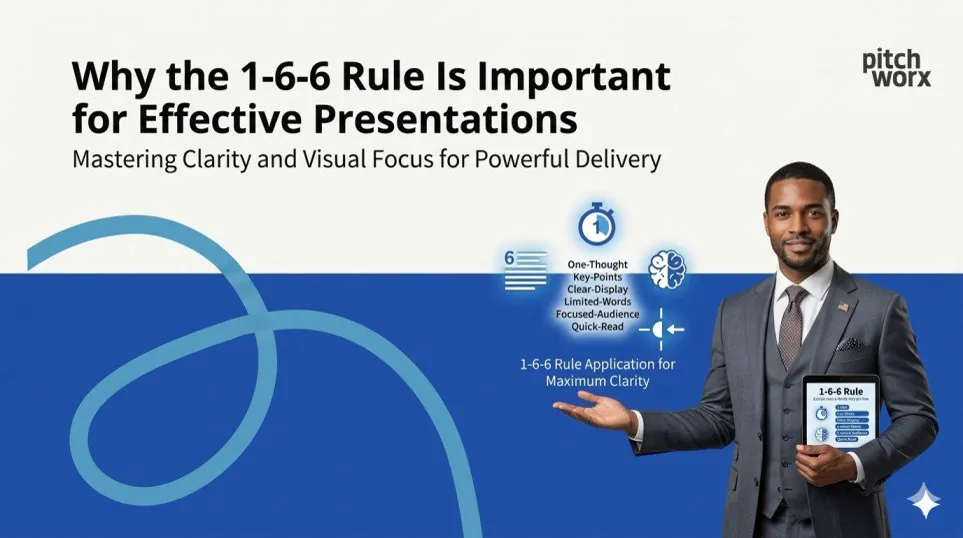
The 1-6-6 rule states that each presentation slide should contain only 1 main idea, a maximum of 6 bullet points, and no more than 6 words per bullet. This keeps slides clean, readable, and audience-focused — preventing the cognitive overload that kills most business presentations.
- Quick Answer
- What Is the 1-6-6 Rule?
- Why Most Presentations Fail Without It
- Breaking Down Each Part of the Rule
- A Real-World Example: The McKinsey Pitch That Won
- How the 1-6-6 Rule Compares to Other Slide Methods
- What Professional Presentation Design Services Do Differently
- Testimonial
- Case Study: PitchWorx and the 1-6-6 Transformation
- Common Mistakes When Applying the 1-6-6 Rule
- Frequently Asked Questions
- Conclusion
What Is the 1-6-6 Rule?
If you have ever sat through a presentation where the speaker crammed paragraph after paragraph onto every slide, you already understand why the 1-6-6 rule exists. The 1-6-6 rule is a slide design principle built around three simple numbers:
- 1 main idea per slide
- 6 bullet points maximum per slide
- 6 words maximum per bullet point
That is it. Three constraints. Yet following them consistently is the difference between a presentation that persuades and one that puts people to sleep. At PitchWorx, a leading presentation design agency with over 13 years of experience, the 1-6-6 rule is one of the foundational guidelines applied across every client engagement — from Series A investor decks to Fortune 500 corporate keynotes.
Why Most Presentations Fail Without It
Research from the University of New South Wales found that people cannot read text and listen to a speaker simultaneously without losing comprehension in both areas. This is called the split-attention effect — and text-heavy slides trigger it every single time.
A 2023 study by Prezi and Atomik Research revealed that 79% of professionals admit they have tuned out during a presentation because the slides were too dense. That is nearly 4 in every 5 people in your next meeting, already mentally somewhere else. The 1-6-6 rule directly tackles this problem by:
- Forcing you to distil each idea to its sharpest form
- Giving the audience a single anchor to hold in their working memory
- Letting the speaker’s voice carry the depth, while the slide carries the headline
Breaking Down Each Part of the Rule
The “1” — One Idea Per Slide
Every slide should answer one question: What is the single thing I want this audience to remember? When a slide tries to communicate three ideas at once, it communicates none of them effectively. The audience does not know where to focus, and the speaker ends up either rushing through or over-explaining.
Professional presentation design services consistently show that one-idea slides produce stronger audience retention scores. According to a Nielsen Norman Group study, users recall 22% more information from content that is presented in clear, chunked formats compared to dense blocks of information.
The “6 Bullets” — Maximum Six Points
Six bullet points are the ceiling, not the target. If you can say it in four, use four. The human working memory, as described by cognitive psychologist George Miller in his landmark research, can comfortably hold approximately 7 items (plus or minus 2) at one time. Six bullets fits cleanly within that range. Seven or more, and the slide starts working against the audience.
The “6 Words” — Maximum Six Words Per Bullet
This is where most people resist the rule — and where it delivers the most value. Six-word bullets force clarity. They remove filler, eliminate passive voice, and strip away jargon. Each bullet becomes a headline, not a sentence. The speaker then expands on it verbally, which is how great presentations are designed to work.
Example of the rule in action:
- Bad Bullet: “We have seen significant growth in our quarterly revenues due to improved product market fit” 1-6-6 Bullet: “Revenue up 38% this quarter”
- Bad Bullet: “Our customer satisfaction levels have remained consistently high throughout the fiscal year” 1-6-6 Bullet: “Customer satisfaction at all-time high”
- Bad Bullet: “The new process implementation has resulted in a reduction of operational costs for the team” 1-6-6 Bullet: “Operations costs cut by 22%”
The right column communicates the same meaning in a fraction of the words — and it lands harder.
A Real-World Example: The McKinsey Pitch That Won
In 2021, a mid-sized UK fintech company was preparing an investor pitch for a £12 million Series B round. Their original deck had 28 slides, many of which contained 10–14 bullet points and dense financial tables.
A presentation design agency was brought in to rebuild the deck from scratch using structured slide principles — including the 1-6-6 rule. The revised deck had 19 slides, each built around a single argument. Every supporting point was trimmed to six words or fewer.
The result? The company secured its full funding target within three meetings. The lead investor specifically noted that the deck was “the clearest and most confident pitch we have seen this round.”
This is not an isolated outcome. PitchWorx has observed the same pattern repeatedly across its client work: decks built on disciplined slide structure consistently outperform dense, text-heavy alternatives in stakeholder meetings.
How the 1-6-6 Rule Compares to Other Slide Methods
Here is a look at how the 1-6-6 rule performs relative to other popular presentation frameworks:
<br> <br>
One of the most important things this chart reveals is that the 1-6-6 rule sits in the practical middle ground — more structured than the open-ended Takahashi Method, but far more actionable for business contexts than the strict minimalism of the Assertion-Evidence framework.
What Professional Presentation Design Services Do Differently
Applying the 1-6-6 rule is simple to understand but harder to execute under time pressure, especially when the stakes are high. This is where professional presentation design services change the outcome.
A skilled presentation design agency does not just apply the rule mechanically. It interprets what the rule means for your specific content, your audience, and the story you need to tell. That means:
- Identifying which ideas are strong enough to carry their own slide
- Rewriting dense source material into six-word anchors without losing meaning
- Designing the visual hierarchy so the one idea per slide is immediately obvious to the eye
When PitchWorx works with clients on complex corporate decks, the first step is always a content audit: every slide is reviewed against the 1-6-6 standard, and anything that violates it is flagged for restructuring before a single design decision is made.
Testimonial
“We handed PitchWorx our internal strategy deck — 45 slides of charts and bullet points. They came back with 22 slides that said everything we needed, each one built around a single, sharp idea. We used it in three board presentations and closed two major contracts off the back of it. The difference in how people responded in the room was night and day.” — Head of Strategy, UK-based Management Consulting Firm
Case Study: PitchWorx and the 1-6-6 Transformation
- Client: A healthcare technology company preparing for a government tender in the UK
- Challenge: The original deck was 52 slides, with an average of 11 bullet points per slide. The content was technically strong but visually overwhelming and difficult to follow.
- Approach: PitchWorx applied the 1-6-6 rule across the entire deck, combined with a clean visual layout and a consistent narrative arc. The final deck was 31 slides. Each slide carried one argument. No bullet exceeded six words.
- Outcome: The company won the tender. The evaluation panel described the presentation as “structured, professional, and easy to assess.” In competitive tenders, evaluators are reviewing multiple submissions under time pressure — clarity is not just an aesthetic preference, it is a competitive advantage.
Common Mistakes When Applying the 1-6-6 Rule
Even teams that know the rule often apply it incorrectly. Here are the most frequent errors:
- Treating six bullets as the target rather than the ceiling — always aim for fewer
- Using six-word bullets as titles and then adding a paragraph of body text below them, which defeats the purpose entirely
- Applying the rule to the wrong content — data slides, timelines, and visual frameworks operate under different principles
- Confusing brevity with vagueness — a six-word bullet must still be specific and meaningful, not a generic placeholder
A professional presentation design agency helps clients navigate these nuances, ensuring the rule is applied with judgment rather than rigidity.
Frequently Asked Questions
1. Does the 1-6-6 rule apply to every type of slide? Not strictly. Data slides, process diagrams, and timeline visuals follow different design logic. The 1-6-6 rule applies primarily to argument slides, narrative slides, and any slide where the goal is to communicate a point to an audience. It is a framework for text-driven content, not a universal constraint on every visual element in your deck.
2. What if my content genuinely requires more than six bullets? That is usually a signal to split the slide into two. If you have eight distinct points that all support the same argument, consider whether four of them can be handled verbally while four appear on the slide — or whether the argument itself needs restructuring into two separate ideas.
3. Is the 1-6-6 rule the same as the 10-20-30 rule? No. The 10-20-30 rule, popularised by Guy Kawasaki, refers to the number of slides, presentation duration, and minimum font size. The 1-6-6 rule operates at the individual slide level and focuses on idea density and word count. The two rules are compatible and often used together.
4. How does the 1-6-6 rule affect presentation design services? Any serious presentation design agency uses structured rules like 1-6-6 as part of their design process. It shapes content strategy before visual design begins. The rule ensures that no amount of beautiful design is wasted on a slide that is too dense to be understood.
5. Can the 1-6-6 rule be applied to existing decks or only new ones? It applies to both. Restructuring an existing deck around the 1-6-6 principle is one of the most common services that professional presentation design services offer. It typically involves a content audit, slide consolidation, and rewriting of bullet points — followed by visual redesign to match the new structure.
Conclusion
The 1-6-6 rule is not a design trend or a stylistic preference. It is a communication principle backed by cognitive science, validated by years of real-world presentation outcomes, and consistently applied by the world’s best presentation professionals.
One idea. Six bullets maximum. Six words per bullet. Followed with discipline, these three constraints do not limit what you can say — they force you to say it better.
Whether you are preparing a board presentation, an investor pitch, or a sales deck, applying the 1-6-6 rule from the start is one of the highest-leverage things you can do. And if the stakes are high enough to matter, working with a professional presentation design agency like PitchWorx ensures the rule is applied with the skill and strategic judgment your content deserves.