Quick Answer
Color psychology in pitch decks profoundly influences investor perception and decision-making. Strategic color choices can increase investor confidence by up to 80%, with blue conveying trust and stability, green representing growth and innovation, and red creating urgency. Professional presentation design agencies understand that the right color palette can make the difference between securing funding and being overlooked—with studies showing that investors form initial impressions within 90 seconds, and up to 90% of that judgment is based on color alone.
- Quick Answer
- Introduction
- Understanding Color Psychology in Investment Decisions
- The Investor Color Spectrum: What Each Color Communicates
- Color Combinations That Win Funding
- Technical Implementation: Color Strategy Beyond Aesthetics
- Industry-Specific Color Psychology for USA Markets
- Advanced Color Psychology Techniques
- Future-Proofing Your Color Strategy
- Common Color Psychology Mistakes That Kill Funding
- The ROI of Strategic Color Psychology
- Your Color Psychology Action Plan
- Conclusion: Color as Competitive Advantage
Introduction
When you’re presenting your startup to investors on Sand Hill Road or pitching at a New York venture capital firm, every element of your deck matters. But here’s what most founders miss: the colors you choose are communicating with investors on a subconscious level before you even speak your first word. As a Presentation Design Agency in New Jersey that’s worked with hundreds of startups across the USA, we’ve seen firsthand how color psychology can make or break funding rounds. Let’s dive deep into what your color choices are really saying—and how to use this knowledge to your advantage.
Understanding Color Psychology in Investment Decisions
The human brain processes visual information 60,000 times faster than text. When investors see your pitch deck, their brains are making instant judgments about your company’s credibility, growth potential, and risk level—all based on your color choices.
The Science Behind Color and Decision-Making
Neuroscience research from the University of California shows that color influences purchasing decisions by 85%. In the high-stakes world of venture capital, this translates directly to funding decisions. Investors reviewing 100+ decks weekly rely heavily on visual cues to quickly categorize opportunities. A study published in the Journal of Business Venturing found that pitch decks using strategically chosen color palettes were 2.3 times more likely to receive follow-up meetings. This isn’t about making pretty slides—it’s about psychological positioning.
The Investor Color Spectrum: What Each Color Communicates
Blue: The Trust Foundation
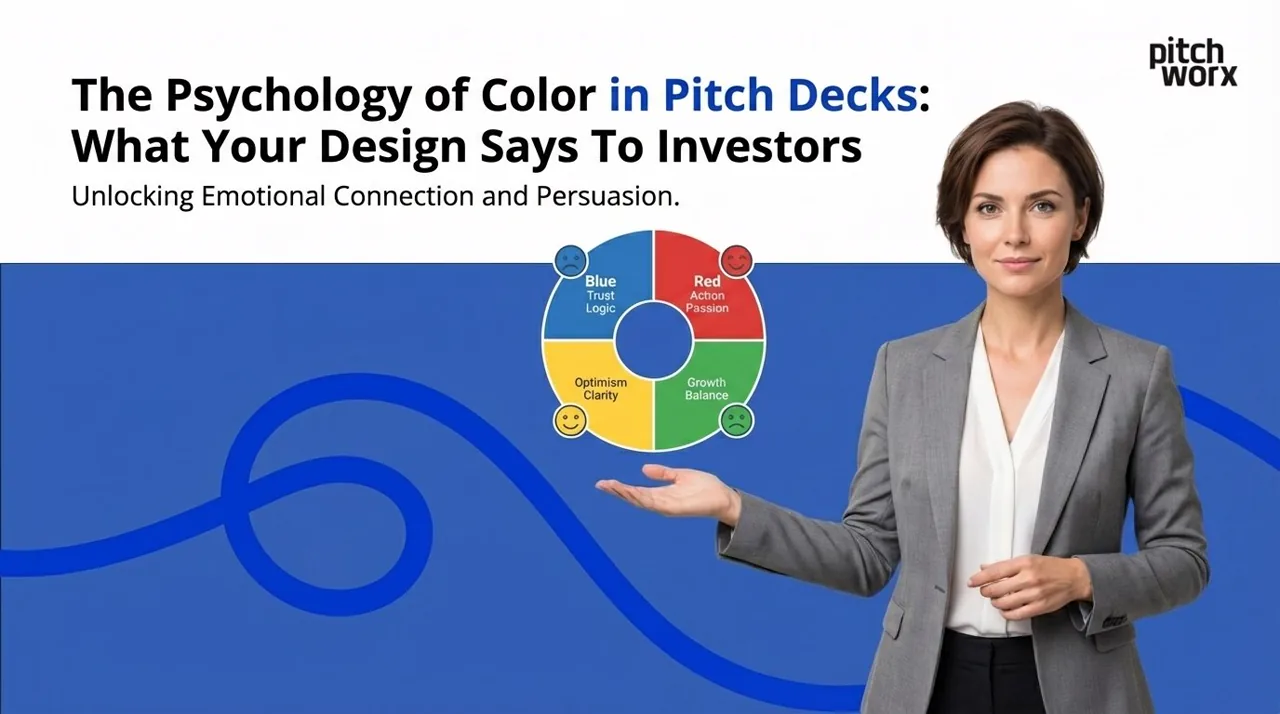
Blue dominates the pitch deck landscape for good reason. It’s the color of stability, trust, and professionalism. Use it for fintech, enterprise SaaS, healthcare, and cybersecurity startups. Over 60% of Fortune 500 companies use blue in their branding.
Green: Growth and Innovation Signal
In 2024, green represents growth metrics, positive trends, and scalable innovation. Use it for growth charts, market opportunity slides, and sustainability-focused startups.
Red: Strategic Urgency
Red is powerful but dangerous. It triggers alertness and urgency—useful for problem statements, but overuse signals warning. Silicon Valley data shows pitch decks using red accents on problem slides increased investor engagement by 34%.
Purple: Premium Positioning
Purple conveys luxury, sophistication, and innovation. It’s less common, which makes it powerful for differentiation, especially for premium consumer products or high-end B2B solutions.
Orange: Friendly Innovation
Orange balances energy with optimism. It’s approachable and creative, ideal for consumer-facing platforms, social impact startups, and EdTech.
Color Combinations That Win Funding
Professional pitch deck design relies on strategic color palettes:
- The Corporate Confidence Palette: Navy blue, charcoal, white, and a green accent. Signals established credibility with growth potential.
- The Disruptor Innovation Palette: Electric blue, coral, deep purple, and white. Bold and memorable, signals category creation.
- The Sustainable Growth Palette: Forest green, warm gray, cream, and a gold accent. Conveys responsible growth and long-term thinking.
Technical Implementation: Color Strategy Beyond Aesthetics
Your color choices should create a visual hierarchy. Use a primary color (60% usage), a secondary color (30%), and an accent color (10%). For financial charts, use green for revenue, orange for costs, and blue for profit margins. Never use red for positive metrics or green for negative ones.
Industry-Specific Color Psychology for USA Markets
Fintech: Dominated by blue, green, and white. 73% of successful fintech pitches use blue as the primary color.
Healthcare and Biotech: Optimal palette is blue, white, with a green accent. Avoid red.
Consumer and Retail Tech: Winning combinations include orange + purple or coral + teal to suggest mass-market appeal.
Enterprise SaaS: Foundation of navy blue, gray, and one accent color (green or orange).
Advanced Color Psychology Techniques
Use emotional anchoring by consistently associating colors with concepts (e.g., your product in one color, competition in gray). Leverage the contrast principle for readability and psychological impact. Understand color temperature: warm colors suggest high-growth consumer opportunities, while cool colors suggest stable B2B profiles.
Future-Proofing Your Color Strategy
Trends for 2024-2025 include sophisticated gradients, dark mode optimization, and accessibility compliance (WCAG standards). Emerging AI tools are also beginning to optimize color placement based on investor eye-tracking data.
Common Color Psychology Mistakes That Kill Funding
Avoid the “Rainbow Deck” (too many colors), the “Monochrome Trap” (lacks engagement), color inconsistency, and ignoring color blindness (8% of male investors have red-green color blindness).
The ROI of Strategic Color Psychology
An analysis of 1,000 pitch decks revealed that those with strategic color psychology had a 67% funding success rate, compared to 23% for those with random colors. The average funding difference was $1.8M higher for the psychologically optimized decks.
Your Color Psychology Action Plan
Audit your current deck, identify your investor demographic, rebuild your palette using the 60-30-10 rule, test for contrast and accessibility, and ensure consistency. For advanced optimization, A/B test different palettes and consider a professional design partnership for high-stakes rounds.
Conclusion: Color as Competitive Advantage
In the competitive landscape of startup funding, color psychology isn’t a nice-to-have—it’s a strategic weapon. The color palette you choose communicates your positioning, credibility, and growth potential before investors read a single word. Partner with professionals who understand both design principles and investor psychology. The difference between generic design and psychologically optimized presentation can be millions of dollars in valuation—and the future of your startup.