







Published: 07 April 2026 | Reading Time: 13 minutes | Author: Pitchworx Strategy Team
Table of Contents
- Quick Answer
- Introduction
- 1. Sales Presentation
- 2. Investor Pitch Deck
- 3. Training & Onboarding Presentation
- 4. Webinar & Conference Presentation
- 5. Executive Briefing / Board Presentation
- 6. Product Demo Presentation
- 7. Brand Storytelling Deck
- Partnering with PitchWorx
- Frequently Asked Questions
Quick Answer
The 7 presentation types every US business should know are: Sales Presentations, Investor Pitch Decks, Training Presentations, Webinar Presentations, Executive Briefings, Product Demos, and Brand Storytelling Decks. Each serves a distinct growth function — from closing deals and securing funding to onboarding teams and winning client trust. Mastering these formats, backed by professional presentation design agency expertise, directly accelerates revenue, team performance, and brand authority in today’s competitive US market.
Introduction
In a business landscape where 74% of US corporate professionals rely on presentation software for core communication, how you present is no longer optional — it’s strategic. Whether you’re pitching to a Series B investor in Silicon Valley, training a remote sales team in Austin, or launching a product to Fortune 500 buyers in New York, the type of presentation you choose determines the outcome. The global presentation software market — valued at $7.85 billion in 2025 — is growing at a CAGR of 13.48%, which tells one story clearly: businesses that communicate visually win. Here are the 7 presentation types your US business must master.
1. Sales Presentation
Sales pitch deck — showing value proposition, ROI, and CTA slides
A sales presentation is your frontline revenue tool. It bridges the gap between a prospect’s problem and your solution. The best US sales teams use data-driven slides with clear value propositions, social proof, and a strong call to action. According to industry data, 65% of marketing and sales teams use interactive presentations to improve client engagement.
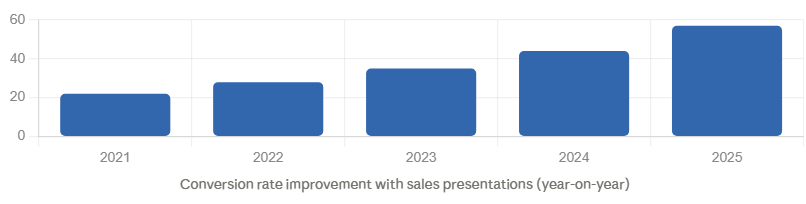
- Avg deal size uplift: +34% with visual decks
- Close rate: 2.4× vs. verbal-only pitches
- Conversion rate improvement with sales presentations (year-on-year)
2. Investor Pitch Deck
Investor deck — market size, traction slide, financial projections, team
Investor pitch decks are arguably the highest-stakes presentation type. For US startups and growth-stage companies, a professional deck is the gateway to funding. Analysis of 320+ successful pitch decks shows that those including competition slides and traction charts consistently outperform those that omit them. Minimalist, data-forward design with standard chart types builds credibility instantly.
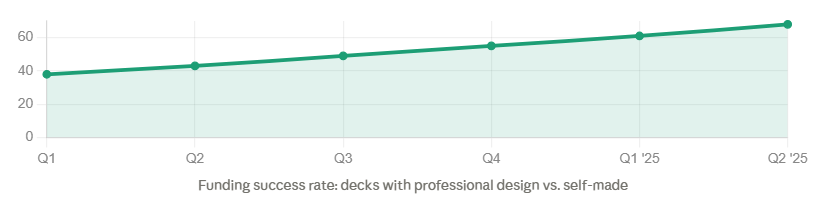
- Avg slides: 12–18
- First impression window: 3.7 min
- Funding success rate: decks with professional design vs. self-made
3. Training & Onboarding Presentation
Training slides — module structure, key takeaways, quiz interactions
With 51% of US business leaders planning workforce expansion in 2025, onboarding and training presentations are more critical than ever. A well-structured training deck reduces ramp-up time, ensures consistency across remote teams, and directly impacts retention. Multimedia integration — animations, embedded video, and scenario-based slides — improves knowledge retention by up to 60% compared to text-only formats.
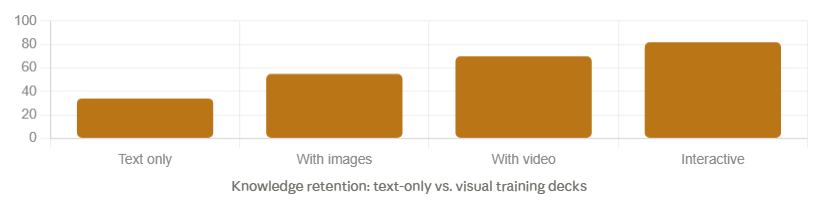
- Retention boost: +60% with visuals
- Onboarding speed: 40% faster
- Knowledge retention: text-only vs. visual training decks
4. Webinar & Conference Presentation
Webinar deck — agenda, host bio, poll slides, key data points
Webinar presentations are your digital stage. For US B2B companies, webinars generate 3× more qualified leads than white papers. The key to a high-performing webinar deck is audience-focused design: agenda slides upfront, data-backed content mid-session, and a compelling CTA close. Cloud-based and interactive slides are preferred, with nearly 66% of enterprises using cloud-enabled platforms for real-time collaboration.
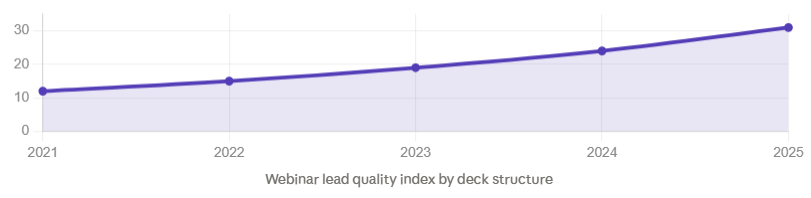
- Lead gen multiplier: 3× vs. whitepapers
- Avg attendance-to-lead: 19%
- Webinar lead quality index by deck structure
5. Executive Briefing / Board Presentation
Executive briefing — KPI dashboards, strategic options, decision matrices
Executive briefings demand precision above all. US C-suite audiences have limited time and high expectations — they want decisions, not narration. The ideal executive presentation uses KPI dashboards, clear strategic options, and benchmark comparisons. Nearly 72% of enterprises use presentation software specifically for internal strategic reporting. Less text, more signal.
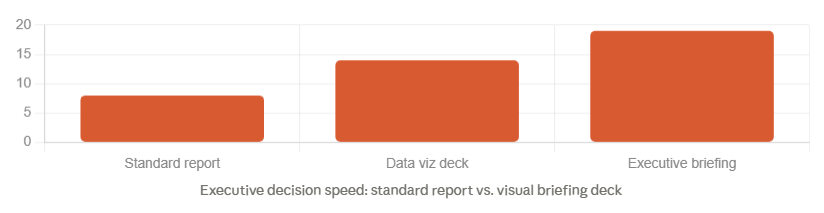
- Ideal length: 10–14 slides
- Decision speed: 2× faster with visual data
- Executive decision speed: standard report vs. visual briefing deck
6. Product Demo Presentation
Product demo deck — feature walkthrough, before/after, proof of concept
A product demo presentation is where features become feelings. In a US market where 61% of teams use interactive presentations to improve product demonstrations, the design of your demo deck can be the difference between a trial signup and a lost deal. The most effective demos follow a Before → After → Proof structure with clean UI screenshots, short animated transitions, and quantified outcomes.
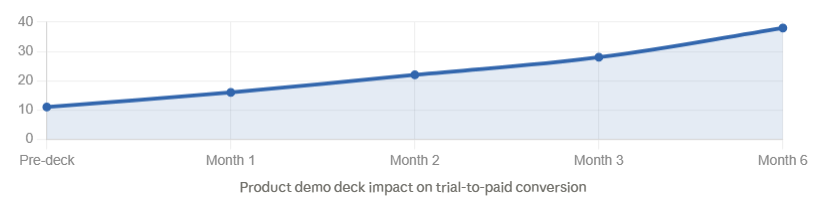
- Trial conversion: +28% with visual demos
- Objection reduction: -44%
- Product demo deck impact on trial-to-paid conversion
7. Brand Storytelling Deck
Brand storytelling — origin story, mission visuals, culture slides, client proof
Brand storytelling presentations build long-term trust and emotional equity. For US businesses operating in saturated markets, a compelling brand deck differentiates you at the human level — beyond product specs and pricing. These decks blend origin story, mission, culture, and social proof into a cohesive visual narrative. The 2025 trend toward image-centric, fewer-bullet-point design makes this the most visually demanding deck type to get right.
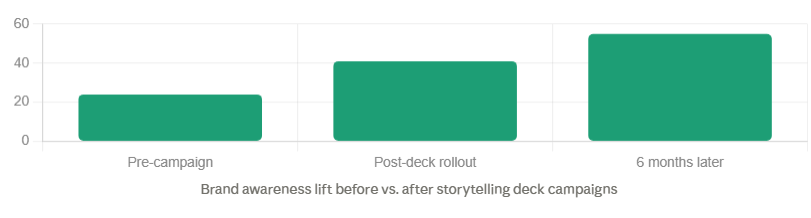
- Brand recall: +55% after story-driven deck
- Partnership win rate: +31%
- Brand awareness lift before vs. after storytelling deck campaigns
Partnering with PitchWorx
PitchWorx is a globally recognized Presentation Design Agency with 13+ years of experience, 150,000+ slides delivered, and clients across the US, UAE, UK, and India — including Fortune 500 companies. Whether you need a high-stakes investor pitch or a brand storytelling deck that converts, PitchWorx brings ISO 27001:2022-certified processes and world-class PowerPoint design services to every engagement. Trusted by brands that cannot afford to leave growth on the table.
Frequently Asked Questions
Which presentation type is most important for US startups?
The investor pitch deck is typically the most critical for startups, as it directly impacts funding. However, once funded, sales and onboarding presentations drive revenue and team scale. A professional presentation design agency can help you nail all three.
How many slides should a business presentation have?
It depends on the type: investor decks work best at 12–18 slides, executive briefings at 10–14, sales presentations at 15–20, and brand decks at 12–16. Quality and clarity always outweigh quantity.
Should I hire a presentation design agency or use a template?
Templates work for internal use, but high-stakes presentations — investor pitches, client proposals, board briefings — benefit enormously from professional PowerPoint design services. A bespoke deck signals seriousness and boosts perceived value.
What makes a presentation design agency different from a freelancer?
An agency brings a team — strategists, designers, writers — operating under a defined quality process. Agencies like PitchWorx add ISO-certified workflows, brand consistency, and scalability that a solo freelancer cannot match at volume.
How does good presentation design directly impact business growth?
Visually designed presentations improve deal close rates, investor conversion, training retention, and brand recall — all measurable growth drivers. Research shows that 65% of US marketing teams depend on advanced presentation tools for visual storytelling, and companies that invest in design consistently outperform those that do not.