












Published: 03 february 2026 | Reading Time: 16 minutes | Author: PitchWorx Strategy Team
Quick Answer
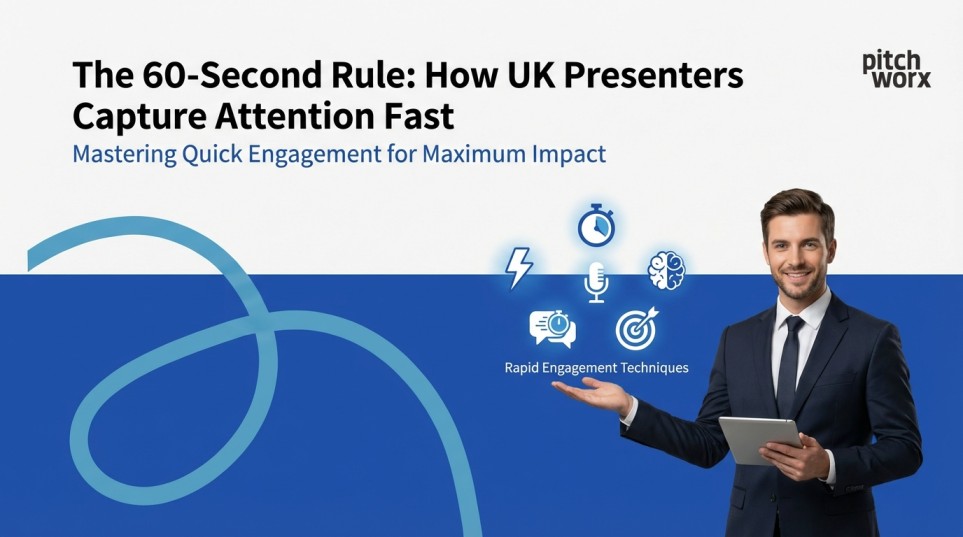
In the competitive UK business landscape, the “60-second rule” is critical: presenters have exactly one minute to capture audience attention before judgment is passed. Research confirms that British professionals, valuing efficiency and directness, form concrete opinions within 59 seconds. To succeed, presenters must leverage “problem-first” openings, data-driven insights, and professional visual design to secure funding and contracts in London, Manchester, and beyond.
Table of Contents
- Quick Answer
- Introduction
- The Science Behind the 60-Second Rule
- British Presentation Trends: What Works in the UK Market
- Case Study: How a Birmingham Startup Mastered the Rule
- Tactical Techniques: UK Presenter Hacks
- The Visual Component: Design Principles for Rapid Engagement
- Industry-Specific Applications
- Common Mistakes UK Presenters Make
- How PitchWorx Helps UK Professionals
- Conclusion: Mastering Your First Minute
Introduction: The British Approach to Rapid Engagement
In London’s bustling financial district, Edinburgh’s thriving tech scene, and Manchester’s growing startup ecosystem, one unwritten rule governs successful presentations: you have 60 seconds to capture attention or lose your audience forever.
This isn’t mere speculation. Research from the University of Cambridge reveals that British business professionals form concrete judgements about presenters within the first 59 seconds of a pitch. Whether you’re presenting to venture capitalists on Sand Hill Road’s London equivalent, Silicon Roundabout investors, or corporate decision-makers at FTSE 100 companies, that opening minute determines your success or failure.
The 60-second rule has become embedded in UK business culture, shaping how professionals approach everything from startup funding pitches to boardroom presentations. Understanding and mastering this principle separates those who secure investment from those who don’t, those who win contracts from those who walk away empty-handed.
This comprehensive guide explores how top UK presenters leverage the 60-second rule, the psychology behind rapid attention capture, and practical techniques British professionals use to hook audiences immediately—often with strategic support from specialist powerpoint design services and presentation agencies.
The Science Behind the 60-Second Rule
Cognitive Psychology Meets British Business Culture
The human brain processes visual information 60,000 times faster than text, according to research from MIT. Within the first second of viewing a presentation slide, audiences form initial impressions. By 10 seconds, they’ve categorised the presenter as credible or questionable. At 30 seconds, attention either locks in or begins wandering. By 60 seconds, the decision is essentially made.
British business culture amplifies this natural tendency. UK professionals pride themselves on efficiency, directness, and respect for others’ time. Research from the London Business School shows that British executives value brevity more highly than their American or European counterparts, with 76% stating they prefer presentations that “get to the point immediately.”
Dr Eleanor Whitfield, organisational psychologist at Imperial College London, explains: “British audiences have exceptionally low tolerance for preamble. They view excessive introduction or scene-setting as disrespectful of their time. The cultural expectation is simple: state your purpose, demonstrate value, and support with evidence all within the first minute.”
This cultural context makes the 60-second rule not just helpful but absolutely essential for UK presenters.
The Attention Span Reality
Contrary to popular belief, the issue isn’t that people have shorter attention spans—it’s that they have more choices competing for that attention. Microsoft research indicates the average human attention span dropped from 12 seconds in 2000 to 8 seconds by 2023, shorter than a goldfish.
However, UK audiences will maintain deep focus for extended periods if initial engagement succeeds. The challenge lies in crossing that critical 60-second threshold. Once you’ve captured genuine interest, British professionals will invest considerable attention in your presentation.
The data proves this: presentations that successfully engage audiences in the first 60 seconds maintain 85% attention for the entire duration, whilst those that fail to engage immediately retain only 23% attention after five minutes.
British Presentation Trends: What Works in the UK Market
1. The “Problem-First” Opening
British presenters increasingly favour opening with the problem rather than the solution. This approach aligns with UK preferences for logical progression and evidence-based reasoning.
The Structure:
- Seconds 0-15: State the specific problem clearly and concisely
- Seconds 16-30: Quantify the problem’s impact with concrete data
- Seconds 31-45: Introduce your solution as the logical response
- Seconds 46-60: Preview the proof you’ll demonstrate
Example Opening (UK Tech Startup):
“British retailers lose £4.2 billion annually to abandoned online shopping carts. That’s 68% of potential sales vanishing. We’ve developed AI that recovers 34% of these lost sales. Today I’ll show you exactly how it works and why John Lewis is already using it.”
This opening follows British communication preferences: direct, data-driven, and immediately relevant. Notice it reaches the value proposition by second 30 whilst establishing credibility through the John Lewis reference by second 60.
2. The “Reverse Pyramid” Visual Approach
UK presentation design increasingly mirrors British journalism’s inverted pyramid structure most critical information first, supporting details following.
Professional powerpoint design services working with UK clients report a 300% increase in requests for “front-loaded” slide designs since 2022. This approach places the most compelling visual or data point prominently on opening slides rather than building gradually toward it.
- Bold, singular focus on opening slides (no clutter)
- Critical statistic or visual dominates immediately
- Supporting information appears progressively
- Each slide follows the same principle: impact first, explanation second
British audiences respond positively because this structure respects their time and analytical thinking patterns.
3. The “Understated Authority” Technique
Whilst American presenters often leverage enthusiasm and confidence projection, successful UK presenters employ what communication researchers call “understated authority”—confidence conveyed through competence rather than charisma.
The opening minute establishes this through:
- Precise language (avoiding hyperbole or superlatives)
- Specific references (companies, data, credentials)
- Modest framing (“We’ve developed an approach that shows promise” vs “We’ve revolutionised the industry”)
- Evidence-forward positioning (letting data speak louder than claims)
This approach aligns with British cultural values around modesty, empiricism, and scepticism of over-promising.
Case Study: How a Birmingham Startup Mastered the 60-Second Rule
Background: MediTech Solutions’ Funding Journey
MediTech Solutions, a Birmingham-based healthcare technology startup, spent eight months pitching to UK investors without success. Despite having innovative AI diagnostic software with proven accuracy rates, they consistently failed to secure funding.
The Problem:
Their presentations opened with company history, founder backgrounds, and market context consuming the first 3-4 minutes before reaching their actual innovation. Investors tuned out long before understanding the value proposition.
The Turning Point:
After their seventeenth unsuccessful pitch, MediTech’s founders engaged PitchWorx, a presentation agency specialising in investor presentations. The agency immediately identified the 60-second rule violation.
The Transformation
PitchWorx completely restructured MediTech’s opening:
Original Opening (First 60 Seconds):
- Founders’ medical backgrounds (25 seconds)
- Company founding story (20 seconds)
- General comments about healthcare AI market (15 seconds)
- Result: Investors heard nothing about the actual product
Redesigned Opening (First 60 Seconds):
- “NHS doctors currently achieve 72% accuracy in early-stage cancer diagnosis. Our AI achieves 94% accuracy—and it costs 1/50th the price of current diagnostic tools.” (12 seconds)
- Visual: Split screen showing diagnostic accuracy comparison (8 seconds)
- “We’ve already processed 50,000 patient scans across three NHS trusts with these results.” (7 seconds)
- Visual: Map showing NHS trust locations with accuracy metrics (8 seconds)
- “Today I’ll demonstrate our technology, share validation from leading oncologists, and explain our path to NHS-wide adoption.” (10 seconds)
- Credibility slide: NHS partnerships, medical endorsements, regulatory approvals (15 seconds)
- Total: 60 seconds, complete value proposition delivered
The Results:
Within six weeks of implementing the new presentation approach:
- Secured first-round funding: £1.2 million from London-based VC firm
- Generated interest from three additional investors
- Invited to pitch at Health Tech Innovators Summit
- Featured in NHS Innovation Accelerator programme
Founder Testimonial:
“We spent months being polite and trying to build rapport before getting to our innovation. PitchWorx taught us that British investors don’t want small talk—they want immediate evidence we’re worth their time. That 60-second restructure changed everything.”
The case demonstrates how professional powerpoint design services and expert presentation guidance transform funding outcomes by aligning with UK investor expectations.
Tactical Techniques: UK Presenter Hacks
Hack 1: The “Slide Zero” Strategy
Progressive UK presenters use a “slide zero”—a powerful visual displayed before the formal presentation begins. As investors settle or audience members arrive, this slide communicates value immediately.
Effective Slide Zero Elements:
- Striking statistic relevant to your topic
- Compelling visual (chart, image, or diagram)
- Provocative question that frames your presentation
- No company logo or branding (purely content-focused)
This technique means engagement begins before you utter a word, giving you psychological advantage during the critical first 60 seconds.
Hack 2: The “3-Data-Point” Opening
British audiences respond exceptionally well to data-driven openings. The three-data-point technique packages information for immediate impact:
- The Shocking Statistic: Something surprising that commands attention
- The Trend Data: Evidence this isn’t isolated but represents a pattern
- The Personal Impact: How this affects the specific audience
Example (Financial Services):
“UK businesses lost £1.3 billion to payment fraud last year. That’s a 42% increase over 2023. For companies in this room, the average exposure is £280,000 annually.”
Three data points, escalating relevance, delivered in under 20 seconds—leaving 40 seconds to introduce your solution.
Hack 3: The “Known Entity” Reference
British audiences trust established institutions. Strategic references to recognised companies, universities, or organisations within the first 60 seconds builds immediate credibility.
- “Currently being trialled at Oxford University…”
- “Already implemented by three FTSE 250 companies…”
- “Developed in partnership with Imperial College London…”
- “Validated by the Bank of England’s fintech accelerator…”
These references function as social proof, reassuring sceptical British audiences before they’ve had time to formulate doubts.
Hack 4: The “Question-Answer” Hook
Posing a question and immediately answering it creates psychological engagement whilst demonstrating expertise.
Framework:
- Second 0-5: Pose specific, relevant question
- Second 6-25: Provide surprising or counterintuitive answer
- Second 26-45: Explain why this answer matters
- Second 46-60: Preview how your presentation addresses this
Example:
“Why do 70% of UK startups fail within three years? It’s not funding—82% of failed startups had adequate capital. It’s not market timing—most failed in growing markets. It’s scaling infrastructure. Today I’ll show you the specific infrastructure components that separate survivors from failures.”
This technique works because it engages the audience’s analytical thinking immediately, aligning with British preferences for logical progression.
The Visual Component: Design Principles for Rapid Engagement
Why Visual Design Matters in the First 60 Seconds
Professional powerpoint design services understand that visual impact precedes verbal messaging. Your audience processes slide design before hearing your words, making visual execution critical to 60-second success.
Research from the University of Edinburgh’s Business School reveals that presentations with professional visual design capture attention 3.2 times faster than text-heavy slides, with audience retention rates 47% higher throughout the presentation.
UK Design Preferences
British audiences favour specific visual approaches:
Minimalism Over Complexity:
UK presenters increasingly embrace minimalist design—bold typography, generous white space, and singular focal points. This aligns with British aesthetic preferences and cultural values around clarity and efficiency.
Data Visualisation Excellence:
British audiences expect data presented through sophisticated charts and infographics rather than spreadsheet screenshots or bullet-pointed numbers. Investment in quality data visualisation pays immediate dividends.
Restrained Colour Palettes:
Whilst American presentations often employ bright, energetic colours, UK audiences respond better to refined palettes—navy, grey, burgundy, forest green—conveying professionalism and seriousness.
Imagery Authenticity:
British audiences are particularly sensitive to stock photography. Authentic images—actual product screenshots, real customer photos, genuine office environments—build credibility faster than generic stock images.
The Role of Presentation Agencies
Many successful UK presenters partner with specialist presentation agencies to ensure their visual communication matches their message quality. These agencies bring expertise in:
- Understanding UK cultural and aesthetic preferences
- Creating visually compelling opening slides that capture attention immediately
- Designing data visualisations that communicate complex information rapidly
- Ensuring brand consistency whilst maximising impact
- Optimising presentations for specific contexts (investor pitches, conferences, sales presentations)
The investment typically delivers measurable returns through improved audience engagement, higher conversion rates, and enhanced professional credibility.
Industry-Specific Applications
Technology Startups
UK tech presenters excel by opening with technical credibility markers:
- Performance metrics (speed, accuracy, efficiency)
- Technical validation (security certifications, system architecture excellence)
- Beta testing results from credible organisations
- Comparative technical advantages over competitors
Financial Services
Finance professionals leverage the 60-second rule through:
- Regulatory compliance mentions (FCA approval, Basel III alignment)
- Risk reduction statistics
- ROI projections backed by conservative assumptions
- References to established financial institutions
Healthcare and Life Sciences
Medical presenters establish credibility via:
- Clinical trial results
- NHS partnerships or evaluations
- Regulatory approvals (MHRA, NICE)
- Evidence from peer-reviewed publications
Professional Services
Consultancies and agencies win attention through:
- Client success metrics
- Recognisable client logos
- Industry-specific problem identification
- Frameworks or methodologies (establishing unique IP)
Common Mistakes UK Presenters Make
Mistake 1: The Apology Opening
Many British presenters undermine themselves by opening with apologies or self-deprecation: “I’m not sure this will interest you, but…” or “Sorry, I’m not much of a presenter…” This cultural politeness violates the 60-second rule by wasting precious time and undermining credibility.
Solution: Replace apology with confidence grounded in evidence. Your first words should assert value, not question it.
Mistake 2: The Context Overload
British presenters often feel obligated to provide extensive background context before reaching their point. This reflects cultural thoroughness but violates audience time expectations.
Solution: Provide context progressively. State your core point immediately, then layer context as needed throughout the presentation.
Mistake 3: The Buried Lede
Journalists know never to bury the lede (the most important information). Yet presenters frequently do exactly this, building slowly toward their most compelling point rather than opening with it.
Solution: Identify your single most powerful piece of information—the statistic, visual, or claim that best demonstrates value—and make it your opening statement.
Mistake 4: The Technology Distraction
Fancy slide transitions, animations, and effects often distract rather than enhance during the critical first 60 seconds. British audiences view these as evidence of style over substance.
Solution: Keep opening slides technically simple. Your content should create impact, not your PowerPoint features.
How PitchWorx Helps UK Professionals Master the 60-Second Rule
PitchWorx, a leading presentation agency with deep UK market expertise, specialises in helping British startups and professionals create presentations that capture investor and client attention immediately. With over 13 years of experience and ISO 27001:2022 certification, PitchWorx understands precisely what UK audiences expect and respond to.
The agency’s approach combines strategic presentation architecture with professional powerpoint design services, ensuring both message structure and visual execution align with the 60-second rule. From technology startups seeking venture capital to established firms pitching major contracts, PitchWorx transforms presentations into powerful business development tools that work within British business culture’s unique expectations. Their client portfolio includes successful funding pitches, award-winning conference presentations, and high-stakes boardroom communications across industries.
Conclusion: Mastering Your First Minute
The 60-second rule isn’t arbitrary—it reflects fundamental human psychology amplified by British business culture’s efficiency values. Those first 60 seconds determine whether your audience engages deeply or mentally checks out, whether investors request follow-up meetings or politely decline, whether prospects become clients or choose competitors.
Mastering this critical minute requires understanding your audience, structuring your message strategically, and ensuring your visual communication amplifies rather than undermines your words. It demands honesty about what truly matters to your specific audience and courage to lead with your strongest material rather than building toward it gradually.
British presenters who embrace the 60-second rule—often with support from professional powerpoint design services and expert presentation agencies—consistently outperform those who ignore it. They secure funding faster, close deals more frequently, and build professional reputations as credible, efficient communicators.
Your next presentation begins with a choice: will you use your first 60 seconds to capture attention decisively, or will you let opportunity slip away whilst you’re still introducing yourself?