








Published: 09 April 2026 | Reading Time: 15 minutes | Author: Pitchworx Strategy Team
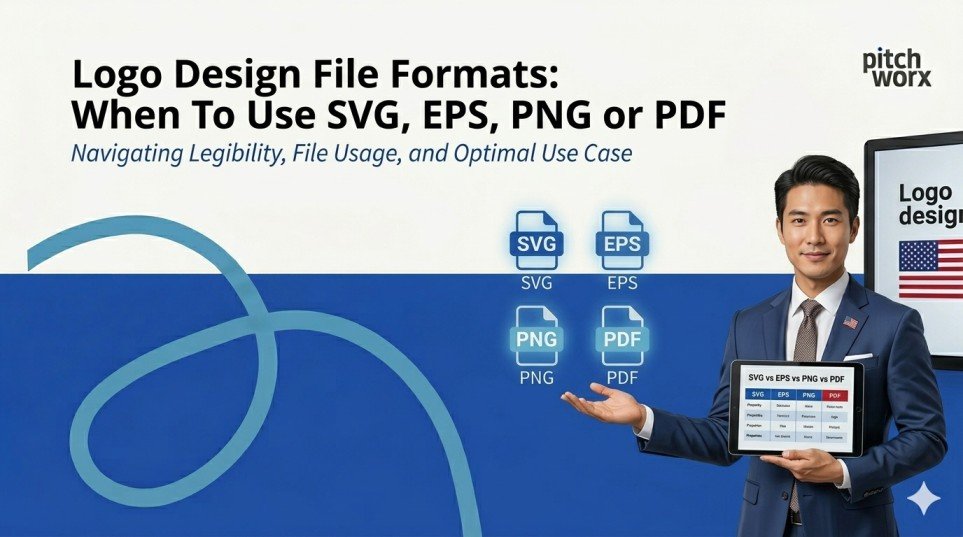
Quick Answer Use SVG for websites and digital interfaces — it scales infinitely without losing quality. Use EPS for professional print jobs like business cards, banners, and billboards. Use PNG for everyday digital use, social media, and presentations where a transparent background is needed. Use PDF when sharing logo files across teams or sending print-ready artwork to vendors. Each format serves a unique purpose, and every brand should maintain all four versions to stay professional across every medium. |
Introduction: Why File Format Matters More Than You Think
You’ve just received your brand-new logo. The designer delivers a folder packed with files — .svg, .eps, .png, .pdf — and suddenly you’re staring at it wondering: which one do I actually use? If this sounds familiar, you are not alone.
Most business owners, marketing managers, and even junior designers treat logo files as interchangeable. They grab whichever file opens first and paste it everywhere — on websites, print collateral, pitch decks, social media. The result? Blurry banners, pixelated business cards, and a brand identity that looks amateur even when the logo itself is excellent.
Understanding logo design file formats is not a designer-only skill. It is a brand survival skill. Whether you are preparing assets for a Ppt design agency to build your investor presentation, or handing files to a printer for a large-format exhibition banner, using the wrong format costs money, time, and credibility.
In this guide, we break down the four most critical logo file formats — SVG, EPS, PNG, and PDF — explain exactly when and where each belongs, and give you a practical framework to never choose the wrong one again.
Vector vs Raster: The Foundation You Must Understand
Before diving into individual formats, there is a fundamental concept every brand owner needs to understand: the difference between vector and raster graphics. This single distinction determines everything about how your logo scales, prints, and performs.
Vector graphics are built from mathematical formulas — points, paths, and curves — rather than pixels. This means they can scale infinitely in any direction without ever losing quality or becoming blurry. Whether your logo appears on a 2-inch business card or a 20-foot exhibition banner, it remains razor-sharp. Vector files include SVG, EPS, AI, and vector-based PDF.
Raster graphics, on the other hand, are pixel-based. They have a fixed resolution. Enlarge them beyond their original size and the pixels stretch, creating that dreaded blurry, jagged look. PNG and JPG are raster formats. They are perfect for their intended uses but become problems when misapplied.
💡 Key Rule: Always maintain both vector and raster versions of your logo. Vector files are your master files. Raster files are created from those masters for specific digital applications. |
SVG — Scalable Vector Graphic: The Web’s Best Friend
SVG stands for Scalable Vector Graphic, and it is the gold standard for anything that lives on a screen. Unlike raster formats, SVG files are built using XML-based code that defines every visual element — shapes, colors, and fonts — mathematically. Modern browsers render them flawlessly at any resolution.
One of SVG’s most underrated advantages is its tiny file size. A high-resolution PNG of your logo might be several hundred kilobytes. The same logo as an SVG might be just a few kilobytes. This makes a measurable difference in website load speed and therefore in your SEO performance.
SVG files also support CSS styling and JavaScript animation, meaning your logo can respond dynamically — changing colors on hover, animating on page load — without a single additional image file. This flexibility makes them indispensable for modern web design, web apps, and digital branding systems.
When To Use SVG
USE CASE | WHY SVG WORKS BEST |
Website header/footer | Infinite scalability, fast load, retina-sharp |
Mobile apps & PWAs | Responsive design, tiny file size, CSS-styleable |
Favicon & app icons | Crisp at any size, no blurring on high-DPI screens |
Animated logo elements | Supports CSS/JS animation natively |
Email signatures | Lightweight and renders in modern clients |
SVG Usage Growth Across Digital Platforms:
Website Logos ███████████████████████████████████████████████████████░░░░░ 92%
Mobile Apps ███████████████████████████████████████████████░░░░░░░░░░░░░ 78%
Email Signatures █████████████████████████████████░░░░░░░░░░░░░░░░░░░░░░░░░░░ 55%
Social Media ████████████████████░░░░░░░░░░░░░░░░░░░░░░░░░░░░░░░░░░░░░░░░ 34%
⚠️ Limitation: SVG is not ideal for print. Most professional printers still prefer EPS or PDF. Some older platforms and CMS systems also don’t natively accept SVG uploads. |
EPS — Encapsulated PostScript: The Print Industry Standard
EPS (Encapsulated PostScript) has been the gold standard of professional printing for decades. It is a vector format that contains PostScript code — a language that printing machines, engraving equipment, and vinyl cutters have read reliably since the 1980s. When you send a logo to a printer and they ask for ‘the vector file,’ they almost always mean an EPS.
EPS files support both CMYK and Pantone color profiles, making them essential for accurate color reproduction in print. Unlike RGB (which is optimized for screens), CMYK is the color system used by ink-based printing. Sending a PNG with an RGB color profile to a printer can result in colors that look dramatically different when they come off the press.
EPS files can embed transparency and support infinite scalability. Your logo can go from a postage stamp to a billboard and look identical at every size. When a powerpoint design services team is creating print-ready materials to accompany a presentation, the EPS is always the source file they reach for.
When To Use EPS
Business cards, brochures, and stationery requiring CMYK color accuracy. Large-format printing — banners, billboards, exhibition stands. Merchandise production — embroidery, screen printing, laser engraving. Signage and vehicle wraps. Sending your logo to any designer or external agency for editing or reproduction.
EPS Usage in Professional Print Industry:
Large Format Print █████████████████████████████████████████████████████████░░░ 95%
Merchandise/Apparel █████████████████████████████████████████████████████░░░░░░░ 88%
Business Stationery ████████████████████████████████████████████████░░░░░░░░░░░░ 80%
Packaging ███████████████████████████████████████████░░░░░░░░░░░░░░░░░ 72%
Signage ███████████████████████████████████████████████████████░░░░░ 91%
⚠️ Limitation: EPS files require Adobe Illustrator or CorelDRAW to open and edit. They are not compatible with standard web browsers or most consumer software. The format is also aging — many modern workflows are transitioning to PDF. |
PNG — Portable Network Graphic: The Digital Workhorse
PNG (Portable Network Graphic) is the most commonly used raster logo format for digital applications. While it is not a vector format and will pixelate if scaled beyond its original size, PNG excels in one critical area that makes it irreplaceable: transparent backgrounds.
When you need to place your logo on a colored background — a social media post, a presentation slide, a website header with a gradient — you need transparency. JPEG doesn’t support it. SVG requires coding knowledge to implement in certain contexts. PNG handles it natively and opens on every device, browser, and software application without any compatibility issues.
For a ppt design agency handling brand assets daily, PNG is the format of choice for importing logos into slide decks, email templates, and digital documents. It is lightweight enough for web use, supports millions of colors, and retains quality through compression and decompression without degradation.
When To Use PNG
✅ BEST FOR | ❌ AVOID FOR |
Social media profiles & posts | Large-format printing (billboard scale) |
PowerPoint & Keynote slides | Merchandise screen printing |
Email newsletter headers | Any print job requiring CMYK |
Website banners (small/medium) | Logos that need to scale to 10x+ original size |
Digital documents & reports | Embroidery or laser engraving files |
PNG Adoption Across Digital Touchpoints:
Presentations (PPT) ███████████████████████████████████████████████████████████░ 98%
Social Media Posts ████████████████████████████████████████████████████████░░░░ 94%
Email Newsletters ████████████████████████████████████████████████████░░░░░░░░ 87%
Digital Ads (Display)█████████████████████████████████████████████░░░░░░░░░░░░░░░ 75%
CMS/Blog Embeds ██████████████████████████████████████████████████████░░░░░░ 90%
PDF — Portable Document Format: The Universal Connector
PDF (Portable Document Format) is the most misunderstood format in the logo file family. Most people think of PDF as a document format — contracts, reports, presentations. But a properly saved vector PDF is one of the most versatile and powerful logo file formats available.
What makes PDF unique is its dual nature. A PDF can contain either vector data (infinitely scalable, professional quality) or raster data (pixel-based, resolution-dependent), depending on the software that generated it. A PDF exported from Adobe Illustrator with ‘Preserve Illustrator Editing Capabilities’ enabled is a fully editable vector file that any presentation design agency or print vendor can open and use without needing specialist software.
PDF also supports both RGB and CMYK color profiles, making it suitable for both digital and print applications. It is universally compatible — every operating system, device, and software application can open a PDF without installing anything extra. This makes it the preferred format for sharing logo assets with clients, vendors, or non-design teams.
When To Use PDF
Sharing logo files with clients or internal stakeholders who don’t have design software. Sending print-ready artwork to vendors who use modern workflows. Creating brand guidelines documents that embed the logo at full quality. Providing logo files to a ppt design agency or presentation design agency that needs to work across multiple software environments. Archiving your master logo files with full editability retained.
💡 Pro Tip: Not all PDFs are created equal. A PDF exported from Canva or Microsoft Word is often raster-based and low quality. Always request a vector PDF exported from Adobe Illustrator or a professional design tool for logo use. |
PDF as a Preferred Sharing Format — Year-on-Year Trend:
Client Handoffs ██████████████████████████████████████████████████░░░░░░░░░░ 83%
Print Vendor Files ██████████████████████████████████████████████░░░░░░░░░░░░░░ 76%
Brand Guideline Docs█████████████████████████████████████████████████████░░░░░░░ 88%
Agency Collaboration███████████████████████████████████████████░░░░░░░░░░░░░░░░░ 71%
Format Comparison at a Glance
📷 [Image: Side-by-side format comparison chart — SVG, EPS, PNG, PDF attributes] | ||||
Format | Type | Best For | Transparency | Scalable |
SVG | Vector | Web / Apps | ✅ Yes | ✅ Infinite |
EPS | Vector | ✅ Yes | ✅ Infinite | |
PNG | Raster | Digital Use | ✅ Yes | ❌ Fixed |
Both | Universal Share | ✅ Yes | ✅ (vector) | |
How PitchWorx Manages Logo Files Across Global Campaigns
At PitchWorx, a globally recognized ppt design agency with over 13 years of experience and 150,000+ slides delivered to Fortune 500 clients across India, UAE, UK, and USA, managing logo file formats is a daily discipline — not an afterthought. As a leading powerpoint design services provider, PitchWorx operates with a rigorous brand asset management protocol for every client engagement.
Every project begins with a logo audit. The team requests files in all four core formats: SVG for web-facing slide elements, EPS for print-quality materials, PNG for quick-use digital touchpoints, and vector PDF for cross-team sharing. This presentation design agency approach ensures that whether a pitch deck is being adapted for a New York investor meeting or a Dubai corporate summit, the brand identity remains pixel-perfect across every output.
This systematic approach to file format management is one reason PitchWorx has earned ISO 27001:2022 certification and maintained long-term relationships with global enterprise clients. As a trusted ppt design agency, PitchWorx understands that great design is not just about aesthetics — it is about precision, consistency, and knowing exactly which file format serves which purpose.
5 Common Logo File Format Mistakes (And How to Avoid Them)
❌ Using PNG for large-format print
✅ Fix: PNG is pixel-based. Enlarging it for a banner or billboard produces blurry, pixelated output. Always use EPS or SVG for anything printed at scale.
❌ Uploading EPS to a website
✅ Fix: EPS is not a web format. Browsers cannot render it. Use SVG for all website logo placements.
❌ Assuming all PDFs are vector quality
✅ Fix: PDFs exported from non-professional tools like Canva or Microsoft Word are often raster-based. Always verify the source application.
❌ Sending low-resolution PNG to a powerpoint design services team
✅ Fix: A PNG that looks great on your laptop screen may print poorly in high-resolution slide exports. Always export PNG at 300 DPI or higher for presentation use.
❌ Not keeping the original AI file
✅ Fix: The AI file is the master source from which all other formats are generated. Losing it means paying to recreate your logo from scratch if you ever need a format not in your current package.
Which Format Should You Choose? A Simple Decision Framework
Step 1: Is your logo going on a website or digital screen? → Use SVG (best) or PNG (simpler). Step 2: Is it going to a professional printer? → Use EPS (always) or vector PDF if EPS is not accepted. Step 3: Are you sharing the file with a team, client, or vendor who may not have design software? → Use vector PDF. Step 4: Are you adding it to a PowerPoint, Google Slides, or email? → Use PNG with transparent background. Step 5: Are you sending it to a ppt design agency or presentation design agency for a high-end pitch deck? → Provide both PNG (300 DPI) and SVG. |
Conclusion
Logo file formats are not a technical detail — they are a brand management decision. SVG keeps your logo sharp on every screen. EPS ensures it prints perfectly at any size. PNG handles the everyday digital world with ease. PDF bridges all environments with universal compatibility.
Whether you manage brand assets for a startup or work alongside a ppt design agency on global enterprise pitches, understanding these four formats gives you control over how your brand presents itself in every context. The right format in the right place is the difference between a brand that looks professional and one that looks careless.
If your current logo package is missing any of these formats, reach out to your designer now. And if you are building a pitch deck, partnering with a specialist powerpoint design services team like PitchWorx ensures your brand assets are handled with the precision they deserve — every time, in every market.
Frequently Asked Questions
What is the best logo file format for a website?
SVG is the best format for websites because it scales perfectly at any resolution, loads fast, and supports CSS styling. If SVG is not supported by your CMS, use a high-quality PNG with a transparent background as an alternative.
Can I use PNG for printing business cards?
A PNG can work for small print items like business cards only if it is exported at 300 DPI at the final print size. However, EPS is always the professional standard for print. Using a low-resolution PNG will produce blurry, unprofessional results.
What is the difference between SVG and EPS?
Both are vector formats, but SVG is designed for digital and web use while EPS is the print industry standard. SVG is readable by web browsers and lightweight; EPS is compatible with professional printing equipment and supports CMYK and Pantone color profiles.
Why do I need a PDF version of my logo?
A vector-based PDF is the most universally compatible file format. It can be opened on any device without specialist software, supports both RGB and CMYK color profiles, and is suitable for sharing with clients, vendors, and teams who may not have Adobe Illustrator.
Should I send a PNG or SVG to a ppt design agency for a pitch deck?
For presentation use, send a high-resolution PNG (300 DPI) with a transparent background. If the presentation design agency works with web-output decks or needs to resize the logo significantly, also include the SVG. A powerpoint design services provider will typically specify which formats they need for your specific project.
How many logo file formats should I have in my brand asset package?
At minimum, you should have: an AI or SVG (master vector), an EPS (print standard), a PNG (digital use with transparent background), and a vector PDF (universal sharing). Most professional designers and any reputable ppt design agency will deliver all of these as part of a complete brand package.